
Gully Labs: Cool From Here
On 'The Indian Dream' and the making of "India's most ambitious sneaker brand"

Over the first six months of 2026 (and the first six months of Next Up India), we’ve unpacked a shifting consumer landscape on the Subcontinent, one that’s seen an inversion from the post-Liberalisation status quo and the automatic deference to foreign things that characterised consumer mindsets here around the turn of the millennium.
What's taking its place is a kind of Indic curiosity, a growing openness from consumers - both Indian and global - to homegrown brands that draw from Indian culture with sincerity and skill. That curiosity is being matched by a generation of founders who are looking at India's vast cultural inheritance as a source of genuine inspiration - as this inexhaustible source of stories, aesthetics and creative raw material.
You can see it playing out across an assortment of categories already - in our coffee, our food, our spirits, our skincare, our fashion. And, as today's piece will attest, in our sneakers.
In 2023, when former JP Morgan investment banker Arjun Singh, and former Bain consultant Animesh Mishra - two self-confessed sneakerheads - returned to India after stints abroad in Australia and the US, they were confronted by a consumer zeitgeist that was still stuck in the past - still infatuated with logos from overseas.
“It felt like everything cool had to come from somewhere else,” says Arjun.
For two sneakerheads yearning for products that represented them and their experiences, that state of play was equal parts disappointing and baffling. Disappointing, because India had no shortage of raw material - it had Phulkari and Kantha and Zardozi, third generation shoemakers, design traditions older than most of the Western brands dominating its malls, and the second largest footwear manufacturing base on the planet. Baffling, because the rest of the world was already happily mining Indian culture for inspiration - repackaging haldi doodh as turmeric lattes, pranayama as breathwork, and mehendi as a Coachella aesthetic.
The problem, as they saw it, was a failure of translation. Nobody here was taking India’s vast cultural capital and presenting it in a contemporary way, via products that Indians themselves would find aspirational.
They decided to launch their new company - Gully Labs - on the heels of that idea, as a sneaker brand designed to carry Indian stories, narratives and traditions, crafted at a standard that could stand at par with anything else in the world.
In just under three years of operations, as outsiders and newcomers to the worlds of fashion and design, they’ve racked up a series of milestones that’s given them a privileged position in India’s cultural conversation. That includes recurring features in Vogue, a spot for Arjun and Animesh on GQ’s list of the most influential Indians, a successful sojourn through India’s Shark Tank, a full throated endorsement by South Indian cinema’s biggest star in one of his biggest hits - finally capping off a frenetic run of form with a Series A funding round that was announced this past January.
Today you’d be hard-pressed to find many new age Indian brands who’ve been as adept as them at threading the needle between content, commerce, community and culture. We’ve been fans and customers of Gully Labs for a while. We appreciate that, at their core, they are a platform for Indian stories that happens to use sneakers as their canvas, just like we do with words and pixels. That shared ground was the basis of today’s piece (which will be deeper than what we’ve done on Next Up India so far, but entirely on brand with what you’d typically find on Tigerfeathers).
So, to unpack their story, Gully Labs co-founder Arjun Singh joined us for a series of interviews that took place over six months, starting last October and finishing earlier this year.
We covered:
- How two guys with zero fashion experience grew a sneaker brand from an Instagram page, a manifesto, and a WhatsApp group
- The art of cultural translation and what it means to invent a contemporary Indian design language from scratch - from adapting Rangoli perforations and Phulkari to taking inspiration from kulfi, hockey and motorcycles
- Pricing, positioning, scale, and the 'original Indian sneakerhead' - the business of building a premium brand in a market conditioned to expect Indian things to be cheap
- What it actually takes to manufacture a hand-lasted sneaker in India - from sourcing leather to managing karigars to surviving the supply chain
- The holy trinity - how Gully Labs threads content, commerce and community into a playbook for brand building and world building
- India's cultural moment, and what it means for founders building at the intersection of heritage and aspiration
For founders and operators building consumer brands, Arjun has been exceedingly generous in sharing his hard-won insights into both the strategy and day-to-day realities of building a brand from scratch.
As you can imagine, there’s a lot to get to this week, so without further ado, here’s our conversation with Gully Labs’ co-founder Arjun Singh👟
I. Origin
Maybe a good place to start, and a good way to frame this conversation, is with your mission. The tagline of Gully Labs is ‘Representing the Indian Dream’. What does that mean exactly? What does ‘The Indian Dream’ mean to you?
It’s a funny line because, for many years, you could argue that the Indian dream was to leave India - to escape here, and not to be in India at all. And maybe that is still the Indian dream for lots of people.
But Gully Labs was built to represent The Indian Dream 2.0, which is to be self-sufficient and self-assured, to not have a feeling of inferiority or inadequacy, to contribute to making this country better. To us, it encapsulates the aspiration to stay back in this country and build something worth staying here for. That’s why we do what we do.
And how does that tie into your own story?
I’ve lived through this journey myself. I grew up in a Fauji family. My dad was in the Air Force. He came from a really small town, a village in Haryana. He was transformed from the type of person you’d expect to come from the real Indian hinterland into someone who was extremely sharp, focused, and disciplined as an officer in the Indian Air Force. I hated the word discipline in those days but he really hammered home that virtue in me.
Beyond discipline though, living in armed forces campuses across India is a little like being part of a cult, in that you have these well defined norms that do not exist in the outside world - how you dress, how you address people, how you behave on the dining table etc. What may be surprising to know is that Fauji kids tend to nurture a strong sense of taste and style - it comes from having strong values and polished mannerisms and presentation. You can never appear sloppy or tired or casual. That probably affects the way I think about our brand today too.
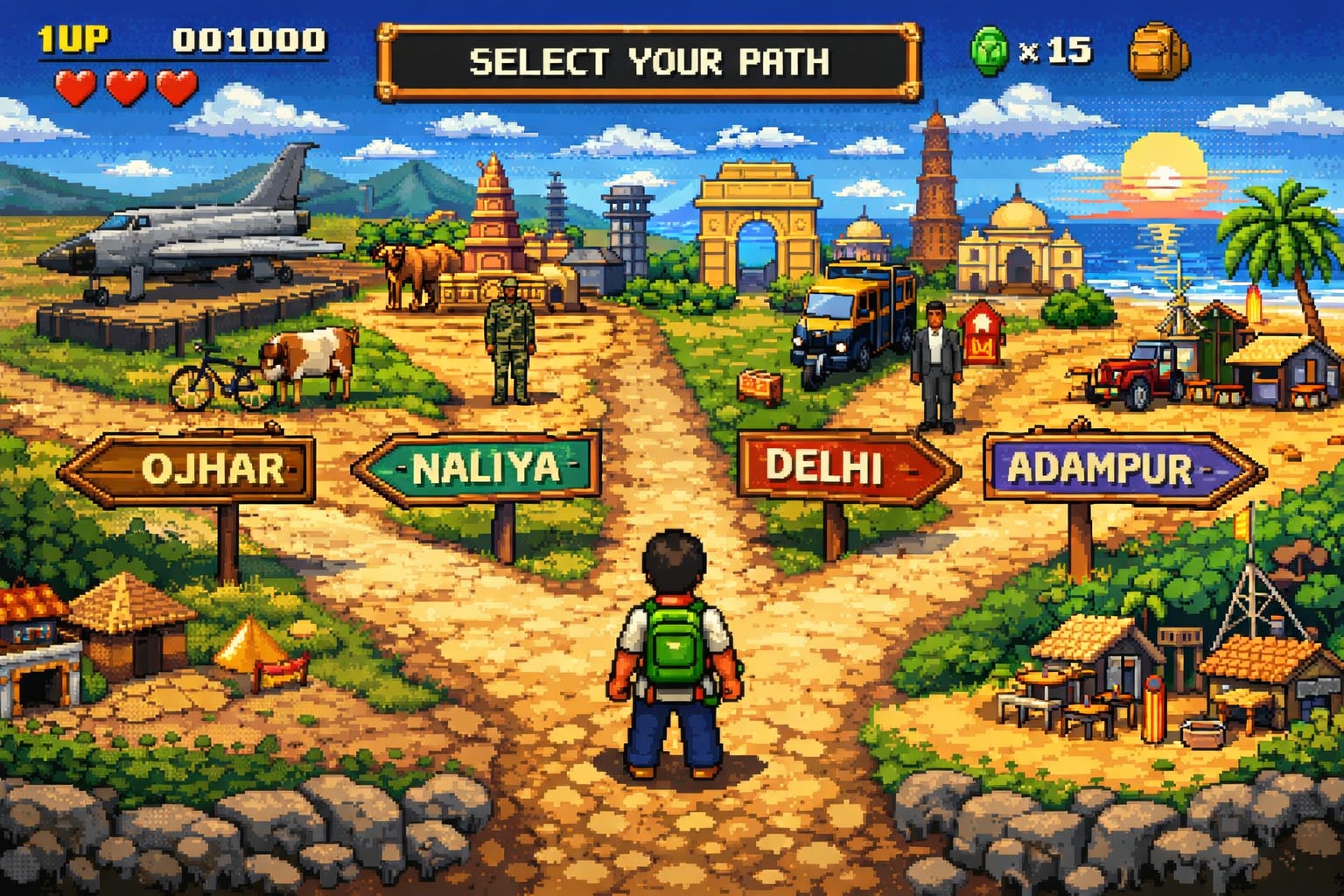
As you can imagine, like any Fauji kid, I grew up all over. I’ve probably lived in 14 cities till date, only spending a year or two in one place. To give you context, when I was in the 12th standard, I was probably already onto my seventh school. I’ve studied in really small towns - Ojhar, Naliya, Adampur - and big cities like Delhi which is where I finally went to college. The ability to move cities every few years also gives you an opportunity to kind of reset your personal narrative in a new place. You get to have new interactions and learn new things about yourself, and then take those learnings to a new place and re-implement them. It’s like constantly iterating on your identity.
So you went to college in Delhi and then later opened the first Gully Labs store there - what did the journey look like in between?
I did my university at the Netaji Subhas Institute of Technology in Delhi. Post uni at NSIT, I had set my mind on the world of investment banking. I had read books like Liar’s Poker and When Genius Failed, and the world of high finance seemed like the fastest route to wealth and status for someone that was starting out at the bottom of the ladder back then.

In Jan 2014, I got a job at JP Morgan’s knowledge centre i.e. their back office in India. On the first day itself I asked my manager how I could transition to the front office, to the main stage. That journey took two years, and ultimately landed me in an analyst’s role in the company’s Sydney office. After almost seven years of corporate life I started feeling the itch to do something more exciting, the itch to do something and create something myself.
So I left JP Morgan in mid-2020 and joined Antler’s accelerator programme in Sydney. I came out six months later with two co-founders and a little startup capital, and we founded a company called m8buy that allowed people to do group buying. That didn’t work out but it gave me the taste for entrepreneurship. The next thing I worked on was a dating app (which only lasted four months). It was a Discord-like platform where people would sign up for 10-minute audio dates once a week. I learned a lot but realised I hated the space. Mainly because you’re in the business of disappointment. The percentage of satisfied users will always be outweighed by the unsatisfied ones.
I also spent time working on the startup investment side with OnDeck, which is where I really saw the power of community in action. I saw the magic you could generate by bringing the right people together. I like to describe communities like gardens - they need nurturing and nursing, otherwise they decay and die away. That experience has directly fed into how I think about Gully Labs even today.
II. The Thesis — From Badass Indians to Gully Labs
Where did the idea for sneakers come from?
Even after shutting the dating app, I was always thinking about the next startup. I weighed up many, many ideas - everything from B2B SaaS to Community stuff to bubble tea. I kept coming back to consumer, and because I always wanted to build a product I could relate with, I kept coming back to sneakers.
I’ve always loved sneakers. The analogy I usually draw is that sneakers are to guys what handbags are to women. It’s one of the few fashion categories where guys can choose to express themselves and actually get noticed. Like, your T-shirt has to be really out there for someone to actually turn their head, but a cool sneaker is more likely to get you a reaction. Maybe you’d say a car or watch would be more fitting here, but those are sporadic purchases. Shoes are magnets for everyday mind share and wallet share.

As someone who falls into this category, I’d always been drawn to sneakers from the West. Brands like Vans were attached to old school skate culture which I loved. I was drawn to Air Jordans because I spent a lot of time around basketball courts in school. Iconic silhouettes like Air Max’s or Adidas Sambas had such rich cultural narratives around them. There was something mimetic about those brands, they were easy to resonate with because you saw your favourite global athletes or musicians or entertainers wearing them. The storytelling gave you a reason to want them.
So when you were looking at this landscape of sneaker brands, what did you think was missing?
I suppose part of it was emotional, and part of it was logical.
On the first, after my initial stint at OnDeck I had moved back to India, to Delhi. The more time I spent re-immersing myself into local life, the more I observed how people made purchasing decisions, I was sort of confronted by this idea that I couldn’t shake - the idea that everything ‘cool’ seemed to come from somewhere else. It’s something that was consistent with sneakers too. Everything in my closet had been born in the West, inspired by someone else’s culture and lived experience. If sneakers are a sociocultural item - a signalling item - then why was I so committed to signalling my affinity with an American or German or Japanese artefact? And why did nothing Indian meet the bar for people’s sense of ‘cool’?
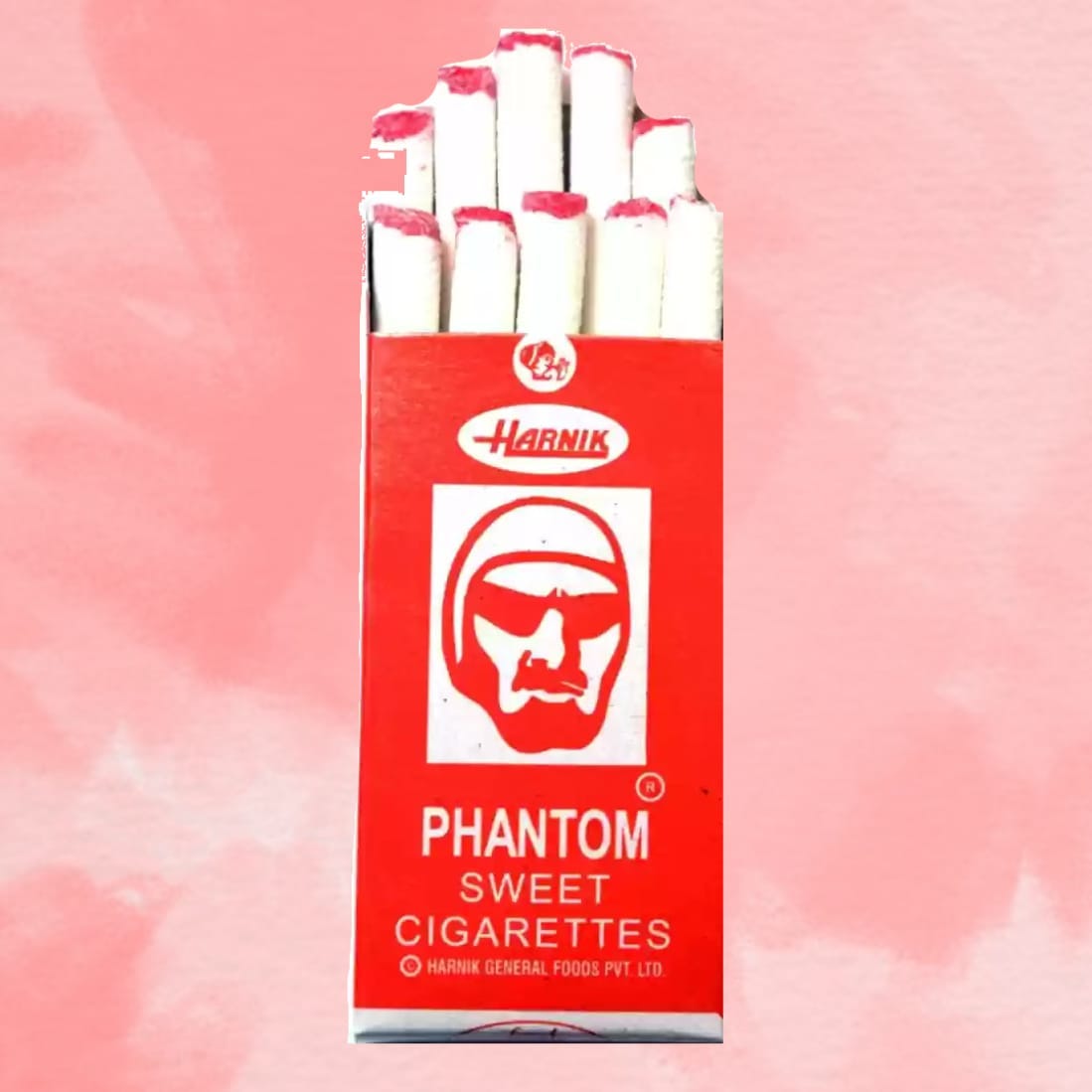
I realised that there was nothing out there that was made ‘for me’. Nothing that had been created with a Subcontinental context in mind, with a different aesthetic that represented the lifestyle or values of someone born here, that could let the world experience a different kind of sneaker culture too. There was no sneaker brand focused on allowing me to flex my Indianness. I couldn’t find anything that matched the quality and craftsmanship of Nike or New Balance, something that was also telling a story through its designs that I could connect with. It felt like something like that needed to exist, to represent the identity and choices of the 21st century Indian. That was the gap I saw.
But even beyond that, if you think about it objectively, sneakers are a strange consumer category because of how concentrated the market is. Like, if I’m buying a product like a perfume, a t-shirt, or a work bag - for any of these everyday consumer goods, I would probably have 100,000 companies out there to choose from. But if you look at sneakers, even the biggest sneaker nerd would be able to name maybe like 10, or at max 20 companies which are responsible for all the sneakers in their closet.
In reality like 50, 60, 70% of the market is owned by just four or five companies. So in a way, this is the most concentrated industry ever. Even if you look at the automobile industry as a proxy, even that seems far more egalitarian in terms of market share. It would be fair to say that a car buyer probably has more brand choices than what a sneaker buyer has, when a car is an infinitely more complex product to make.
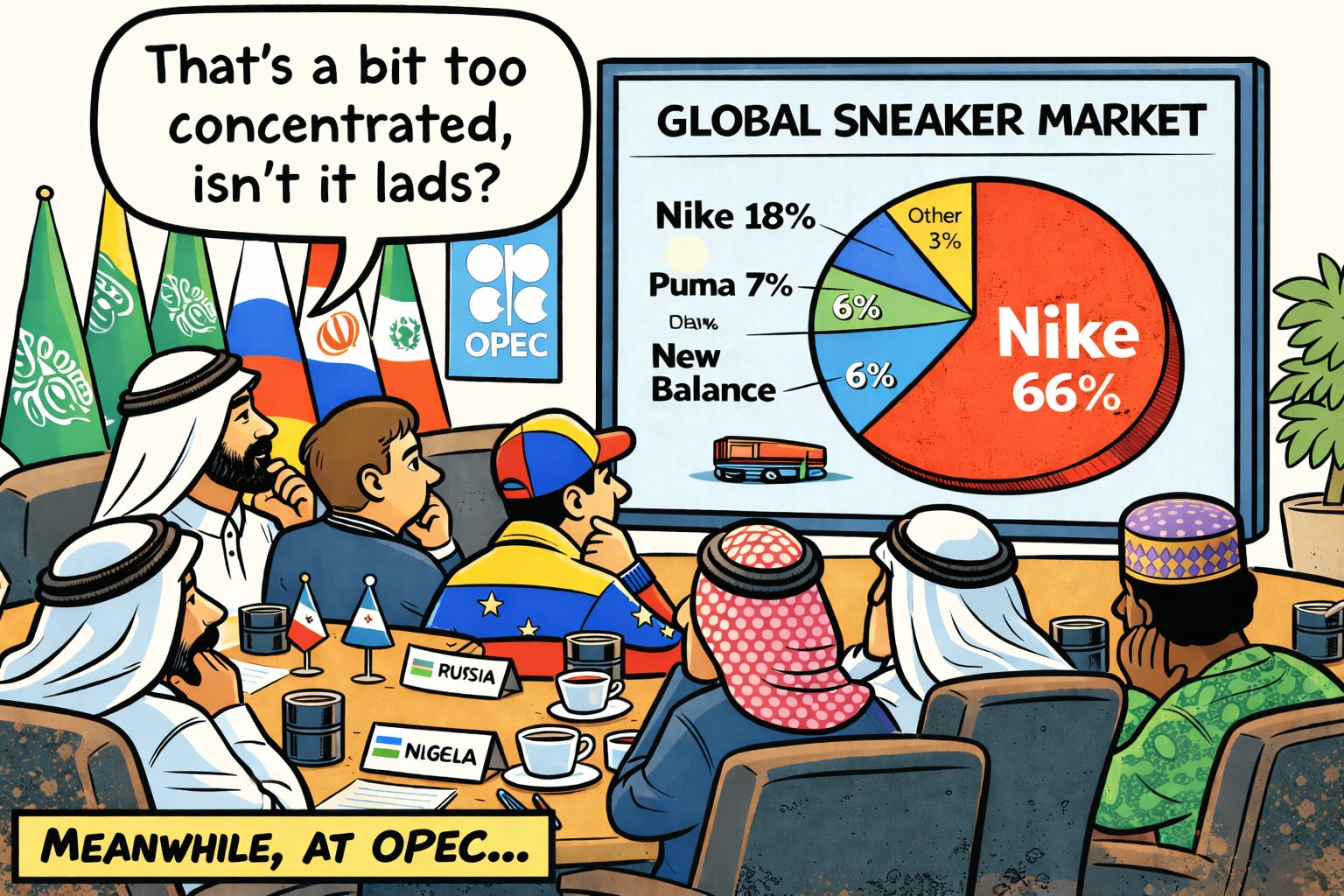
People used to say that ‘the sneaker market is saturated’ but all I saw was the same handful of brands that everyone wore, that were each remixing the same handful of successful designs. Even today when people ask me things like ‘do we really need another sneaker brand?’ or ‘why does India need its own sneaker brand?’, my answer is that there are still too few sneaker brands! Why should people be limited to just the Swoosh or the Three Stripes or the Big N? It made sense that people would look for more ways and more brands that allowed them to express themselves. That gave us the signal that there should be more sneaker companies.
I should add that all through this time, my original plan after returning from Australia was to eventually move to the US. And that might have still happened but I missed my visa appointment, and the next appointment was many months later. During that interim period I found conviction to start testing this Gully Labs idea. And that’s kept me in India till today.
III. Pre Launch
Where did the name come from?
We wanted something that was intrinsically, unmistakably Indian, but also very global at the same time. If you say Gully Labs in Delhi, in Bombay, in a town like Ludhiana or Jaipur, but also say it in London or New York, it just rolls off the tongue, right?
‘Gully’ obviously is a throwback to growing up in India. Everyone in India knows what a Gully is, but it exists in other languages too. It’s a geographical term. It’s a cricket position. But in India, it has this very defined, specific meaning that goes beyond the literary sense. It’s your street, your neighbourhood - where you come from. It speaks to your identity. For us, it’s not a pejorative or a throwaway street term, it’s a stand-in for the kinds of places we grew up around.
And ‘Labs’, as in we wanted to be experimental, opinionated, out there. We can’t be safe, we can’t be perfectly manicured. So that’s why Gully Labs. The name just stood for a lot of different things. It felt organic, and once we settled on it we couldn’t find anything to dislodge it. Nothing else stuck.
What was the first step to turning this into reality? Start drawing up designs?
No actually we didn’t start with a product at all. We started with the community. I’ll rewind back a bit. So by mid-2020 I had left JP Morgan and joined the Antler accelerator. I was really curious about the whole startup scene and still living in Sydney at the time. I had the itch to do something on the side.
I also had a bit more time on my hands than I did in the banking days, so along with one of my friends from Delhi - Rahul Seth - we started an Instagram page called Badass Indians. The goal was to not be like Humans of Bombay or Humans of New York, but to find and spotlight folks from India who had led interesting and unconventional life journeys, and create captioned posts with their photos.
We thought we’d do a few posts every week. But both of us soon got busy with other things and that page lay dormant with just 6-8 posts uploaded on it.
Fast forward a couple of years when I was back in India and the idea for an Indian sneaker brand had taken root, I decided to basically just repurpose that Instagram page. I changed the name to Gully Labs, added the logo, and archived all the old posts, and then started posting content about the mission, the ideas, the ethos of the brand. I had drafted this manifesto (which is still on my website) that laid out my feelings on why this initiative was important, and why it needed to exist.
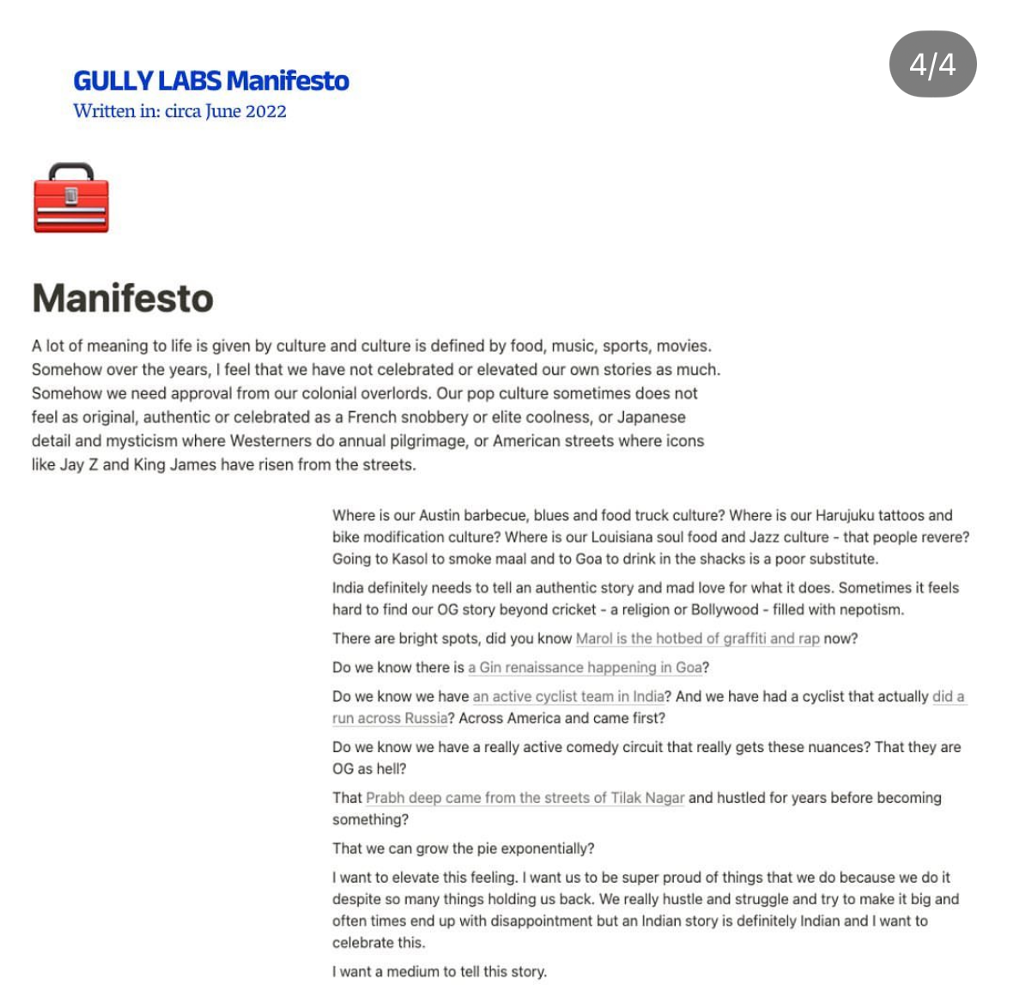
My thinking was that this needed to be a bottoms-up story. We needed people to buy into this journey, to feel an affinity for the brand, and together turn this into reality. We couldn’t force it down people’s throats.
The algorithm Gods helped to get that page in front of the right people. We started building a nice base of supporters - a combination of friends, friends of friends, strangers on the Internet that were aligned with what we were doing, folks that were curious about what was happening here. It was nice not to feel alone while nurturing this idea, and it turned out my future co-founder was in that group as well.
You were effectively manufacturing desire and demand before you manufactured any shoes.
Pretty much. Once the page had enough traction, I added a link to a Whatsapp group in the bio. I started sharing more substantial updates there, like ‘this is what we’re upto’, ‘this is how we’re thinking’, ‘this is how we’re envisioning the first shoe’, ‘this is what we’re doing next’. The group turned into this incredible resource for encouragement, problem-solving and feedback.
Then one day I announced we were opening up for pre-orders. I said that our first shoe would arrive sometime in the next five to six months. I basically said that we had confirmed our first silhouette, that we had shortlisted five colourways, and that you could pay Rs. 1000 to confirm your booking. I shared some initial renders but I didn’t reveal the final design or the final price. I also said they could get a full refund if they weren’t happy later on.
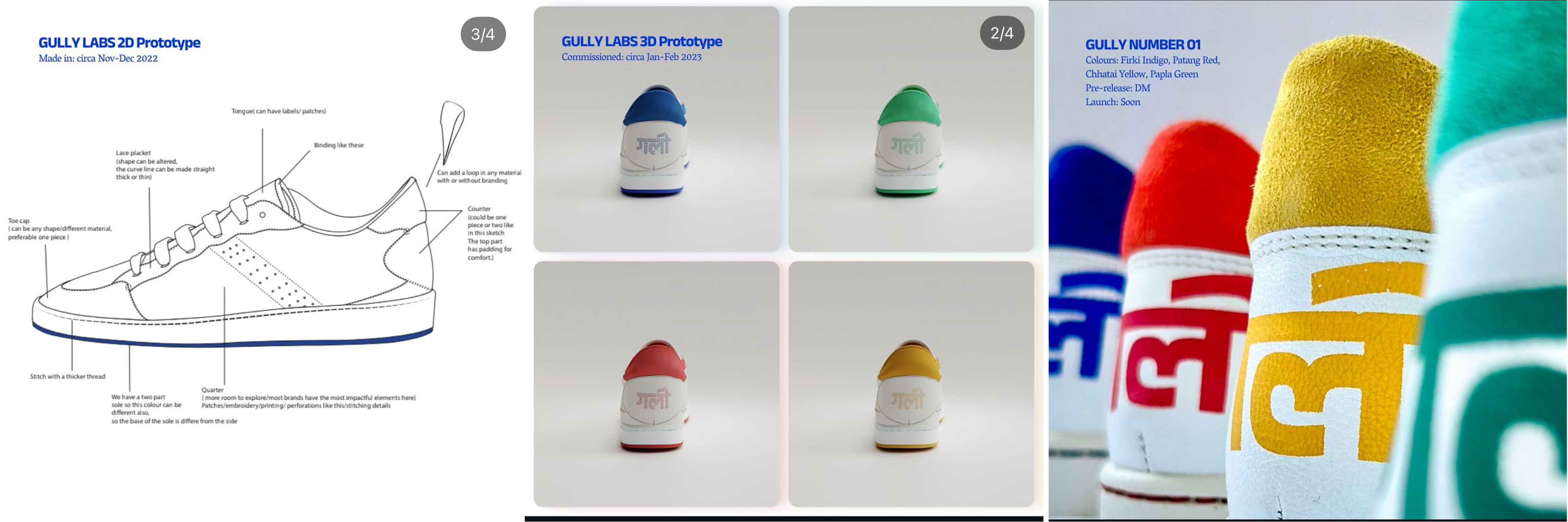
We got somewhere between 50-100 pre-orders. Every single one of those individuals ultimately paid the full amount (Rs. 6000). Those were the early believers. They gave me the confidence that ‘Okay, there’s something real here. People are willing to put down actual money for a shoe they haven’t seen from a brand that doesn’t even exist yet, purely on the strength of the story and the manifesto.’ By the way, one of those individuals was my co-founder Animesh. That’s how he first engaged with the brand, as a paying customer who believed in the vision before the product even existed.
IV. The Company
Would be good to clarify here - there was no ‘company’ at all at this point still?
There was nothing! There was no pressure, there was no funding, there was no team, there was no deck, there was no expectation for anyone to be part of this operation other than the love of the game. That’s what just kept all of us going. I was still working a full time job. The money from that helped to fund all the early efforts. We basically started with that Instagram page and just kept going till we got to a point where we were selling shoes and became an actual company.
When did Animesh formally come onboard? And what made you believe that he was the right partner for you?
Animesh is actually my junior from NSIT - he was four years behind me. We knew of each other but had never really hung out in college. In September 2022, there was an NSIT alumni meetup. It’s the only alumni meetup I’ve ever been to, and it’s the only one Animesh has ever been to. We just happened to show up on the same day.
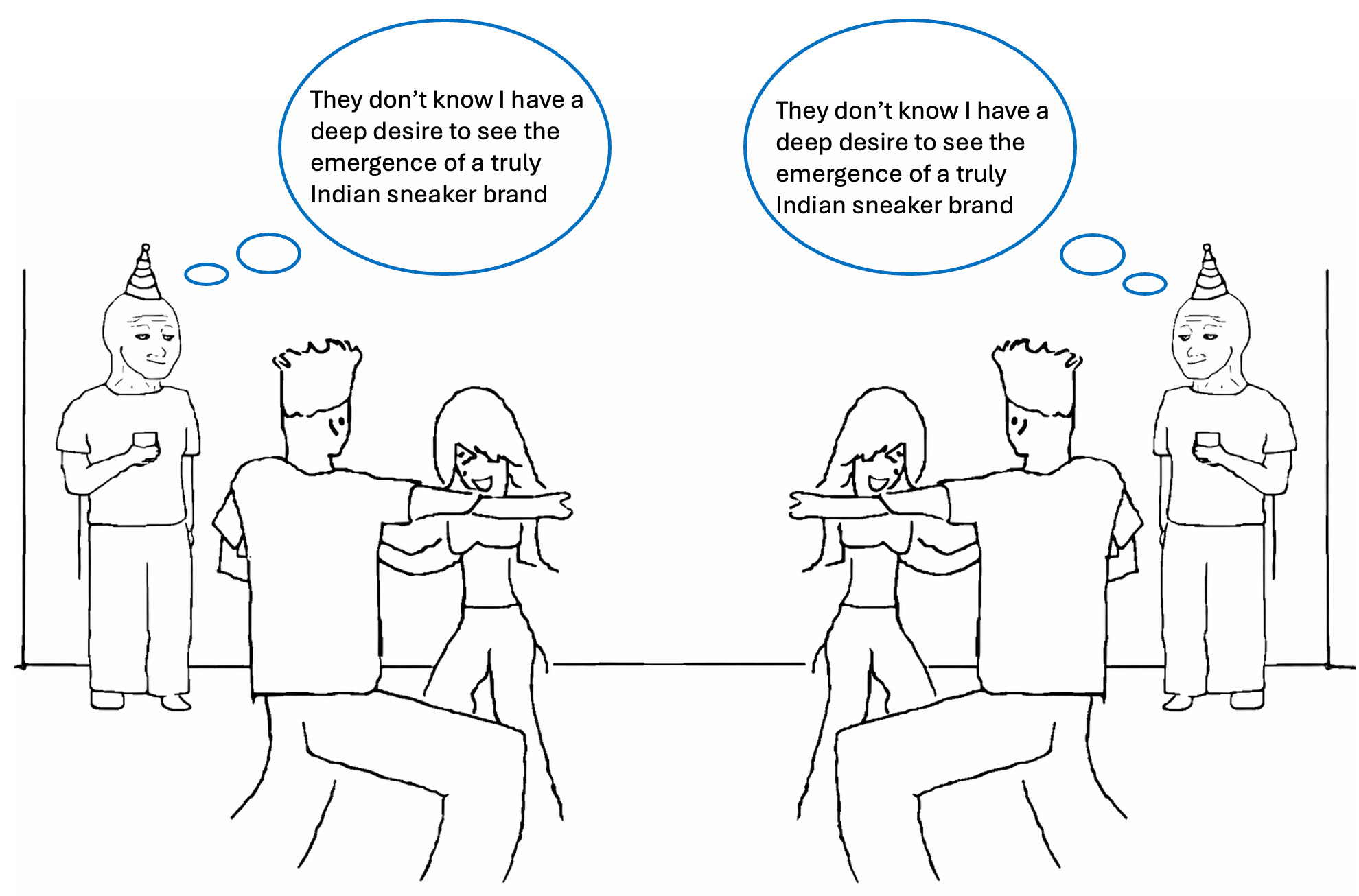
By that point I’d already started working on the Gully Labs idea - the Instagram page was up and I was putting out content about why this brand needed to exist. At the time Animesh was working at Bain. He had previously been in the US on a project with the company and had just moved back to India himself. It turned out that he was sitting on this similar frustration, that India had so much culture to export and share with the world but seemingly nobody was focused on tapping into this opportunity. Nobody was creating products for people like us, that we could proudly champion on the global stage.
He was like me in lots of other ways too in that he was a genuine sneakerhead - way more than me actually. He had spent time in the US collecting limited edition pairs, and understood the product, the buyer persona and the ecosystem deeply. And he was interested in community, in getting people together around common interests. So there was this very natural overlap. In general he’s a super talented guy, interested in many different things.
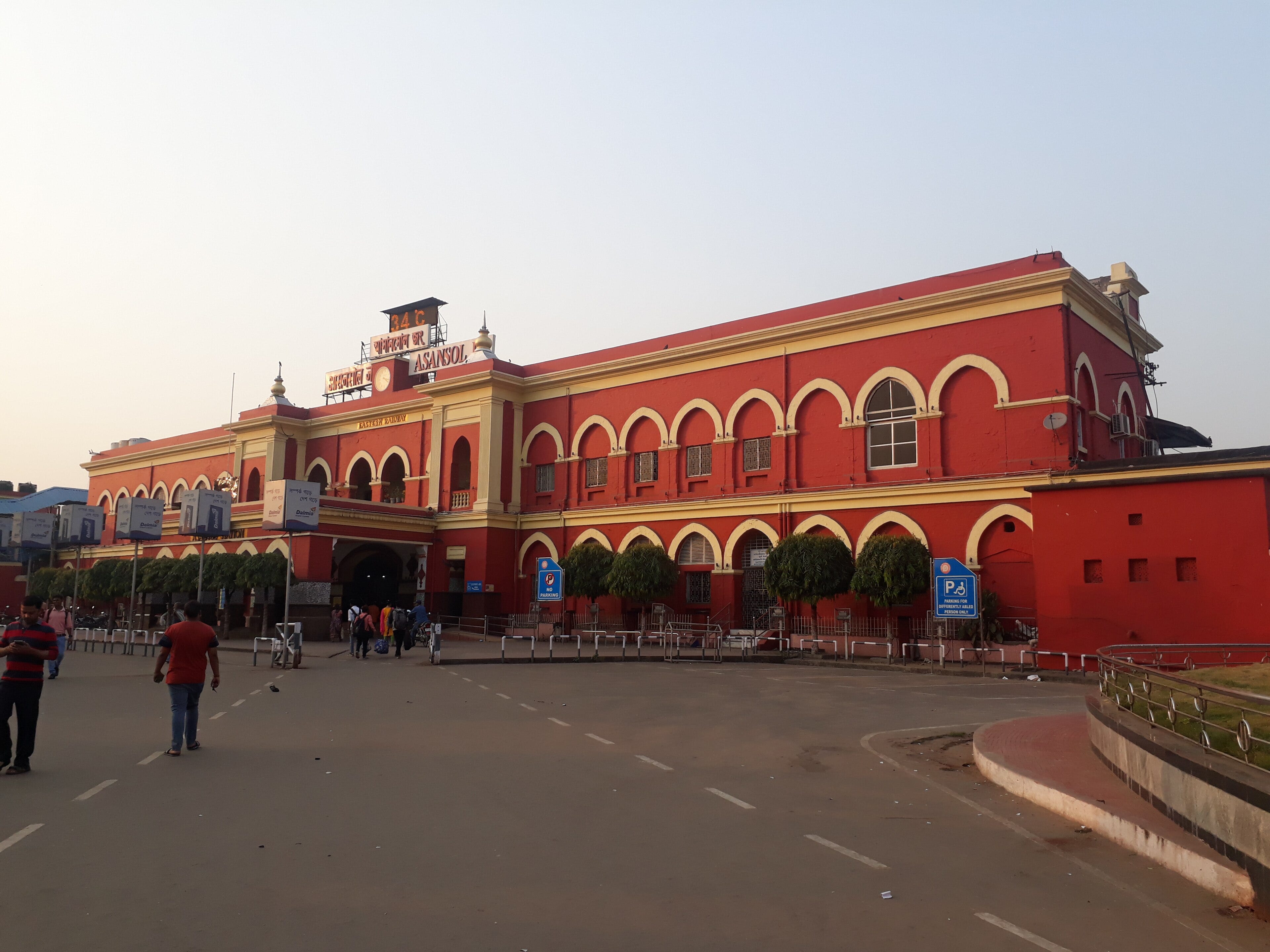
Like, he grew up in Asansol - this small city in West Bengal. His dad played football there. He moved to Bokaro in Jharkhand for high school, then to Delhi for NSIT.
Animesh has always been into dance, hip-hop specifically. He was also into theatre, made Formula Student cars in college, played cricket for the college team. Then he went through a string of corporate jobs - engineering, consulting - the usual drill - and then ended up at Bain. He went to the US on a transfer where most of his peers were all preparing for MBAs. But he had this realisation that he didn’t want to surrender all his work experiences just to go to B-school. There was always a part of him that wanted to try more things just like me. And that took him back to India where we connected and starting jamming. It just clicked.
Like I mentioned earlier, Animesh actually bought two pairs of the first Gully Labs drop during the pre-order phase before even joining. He was fully on board with the mission. So he started helping out while still at Bain, spending nights and weekends on Gully Labs stuff. Eventually he put his papers in around September 2023 and was fully in by November. These days I probably spend more time on the commercial side whereas Animesh goes deep into product. But honestly there’s a ton of overlap. We’re both in weeds on brand and positioning. And the truth is, when you’re this early, everyone does everything. For example, we were both packing boxes and shipping orders when the orders were still in the manageable range.
In general both of us really admire the organisational model that LVMH built - where they have this top layer of strong business folks and then a layer of creative directors under it. It’s the kind of structure we can see us resembling. Funnily enough the actual first model we were looking to replicate was not a fashion company at all, but a sporting organisation. Like in our first vision statement we sort of declared that we want to build something that resembles a football club - something that has a strong sense of identity, culture, fandom, and legacy, where people are motivated by a larger purpose to show up everyday for each other.
So you guys were doing this alongside your ‘real’ jobs for a while? Was it a while before you actually quit?
We went all in on this idea much, much later. The project started in early 2022. I met Animesh in the second half of that year. I still had a full time job and other work commitments till August 2023, which is when I decided to focus all my attention on Gully Labs. Animesh joined me full time formally soon after. We had done about 100 shoe sales by then, but at the end of that year we had our big viral moment, after which we were off to the races.
What was that moment?
This was December 2023. We’d been selling in small numbers till then - maybe 10, 20 pairs a month - very much still in project mode. We’d given shoes to a few people, just on the basis of, ‘hey, if you like it, talk about it.’ No payment, no formal influencer arrangement or anything.
One of those people was Kush Sachdeva, who’s a sneakerhead and sneaker content creator. He made this reel titled ‘top five Jordan alternatives’ - and we were the fifth one at the end. The video was actually long, like 40-60 seconds, which in the reels world is harder to go viral because people usually don’t stick around. But somehow it went to 7 million views.
And then another fashion and lifestyle creator Anuj Dutta put out another reel around the same time. These two back to back reels plus our own storytelling were a sudden catalyst to widespread awareness.
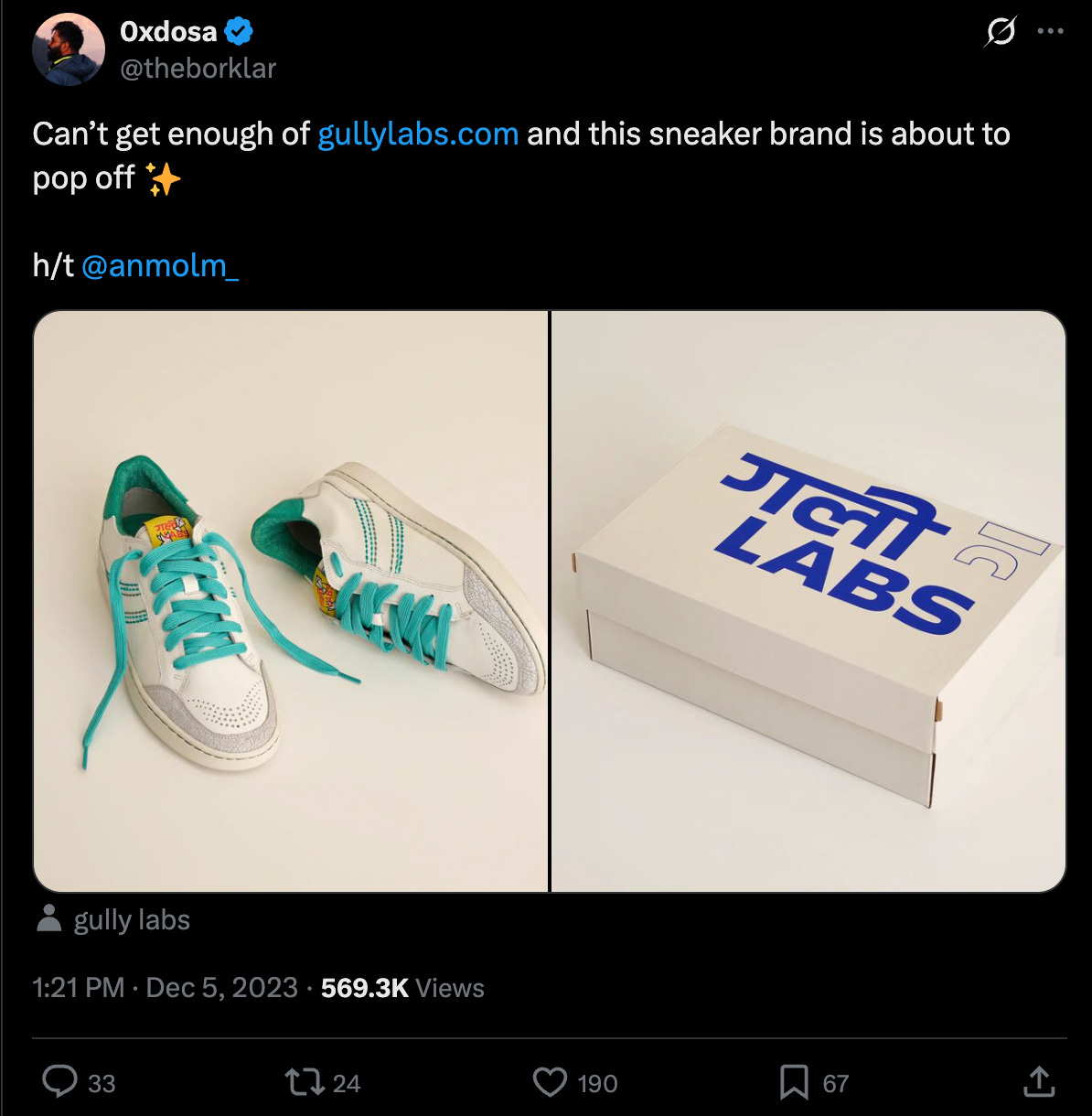
And then simultaneously, someone on Twitter put up a post saying, what is this cool stuff someone’s making out of India? That got traction.
And then someone else put up a hate thread, basically saying, who do these guys think they are, charging these prices for Indian shoes.
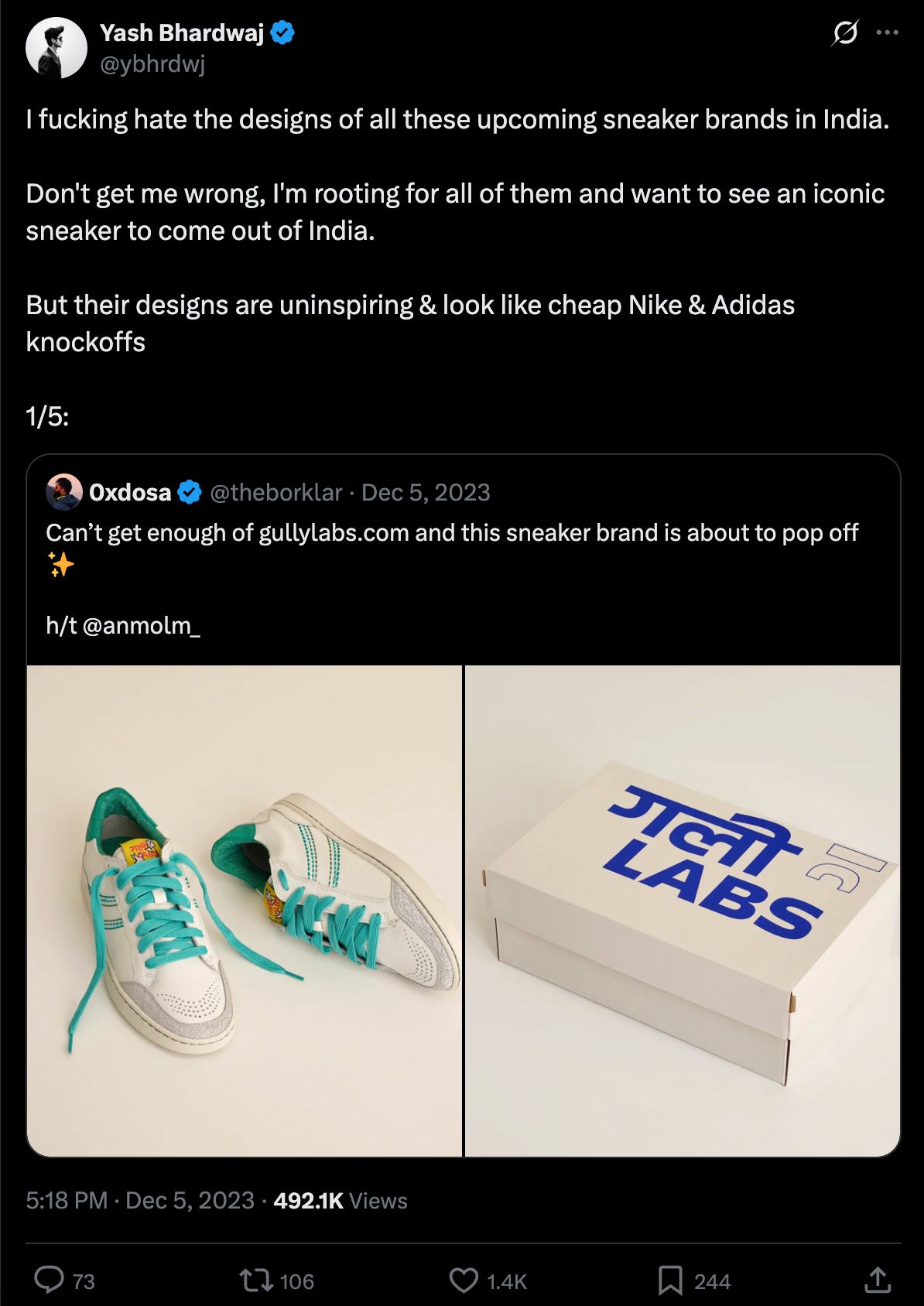
So we had this simultaneous positive loop and hate loop across two platforms in the same week. And the hate thread actually drove a ton of sales too. Because people get intrigued, right? They get curious about why someone else is so angry about a sneaker brand? They want to check it out themselves. Some of those people see the product and like it, so they order for themselves or their friends. It’s a viral loop.
We sold out of everything. Literally had no stock left. And Animesh and I looked at each other and said - okay, this is not a project anymore. This is a company. And that’s when we decided to go full time and set up manufacturing ourselves.
How were you going to fulfil these orders? Had you raised any funding by then?
No it was a mix of bootstrapping the venture ourselves, and we did a small friends and family round of funding. We had received a few VC term sheets as well but we said no to all of them. From a company perspective we only wanted to surround ourselves with true believers at that stage - college friends, people in the Whatsapp group, people we’d worked with before etc. There were 19 individual investors in total, each of whom we knew personally. They put in a range of 2-15L each - with enough warning from us to only put in what they were prepared to lose completely! So all in all it made sense to us to keep a very tight investor circle - people that we could lean on and rely on.
And how did you literally fulfil these orders - who made them? Neither of you had a shoe background right? How did you put the pieces of the manufacturing puzzle together?
This is the classic entrepreneur’s dilemma, which is that you have this desired end state, and your job is to work backwards to figure out how to get there. We just went about it logically.
Like, okay so we need to create a shoe → that means we need materials to create the the kind of shoe we want → which means we first need to design what this shoe looks like → which means we need to find someone who knows how to design shoes → that means we need to find this person and convince them to do this for us.
So first we found a design intern - Aditi - on Internshala who could help us create renderings of the sneaker we had in mind. She was living in Ahmedabad at the time. We had never met her in person but brought her on board. She scoured the Internet and found a real footwear designer and craftsman - Anshul Tyagi - who is still our Product Design Lead today. We sort of contracted Anshul to spend 5-10 hours a week working to bring our initial designs to life. It wasn’t some huge amount we were paying him. It’s just that he seemed like the right kind of crazy for us, and he was excited to be along for the ride too.
The brief to him was - ‘we want to build an Indian sneaker brand that can hold its ground not just in India but on the global stage too - what kind of shoe can we start creating together?’. He started mocking things up on Figma for us. Then the next challenge was how to start prototyping this. He laid out two options for us. He said either we can go with an established large contract manufacturer, or “Hey actually I know this aunty in Noida who works with a few karigars in a garage - maybe she can help us”. In a long series of things we have done after being advised against doing it, we took option 2, which meant getting hands-on with the manufacturing ourselves, something we still do today in our own manufacturing unit. Aunty has sadly passed away recently but played an important role in our early journey.
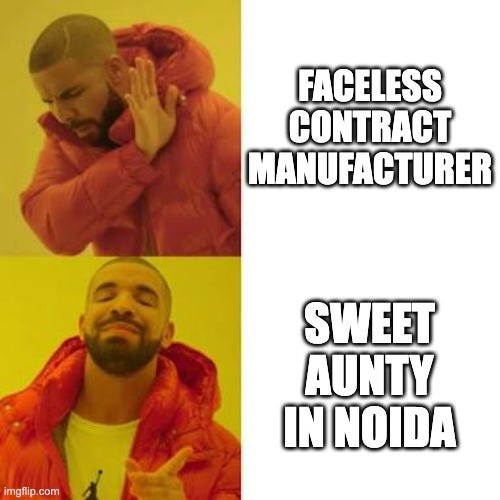
That process was excruciatingly slow. It took lots of iterations and mistakes and zero-to-one steps, but we got there in the end. It took almost a year until we could properly launch with a reasonable consistency of timing and output. But it allowed us to learn a lot, being close to the production, and that choice has served us well today. This group together collectively manifested the vision of what an Indian sneaker brand should look like.
V. The Design Philosophy
Let’s go deeper into that. What does an ‘Indian sneaker brand’ even mean from a design perspective? What was the initial design philosophy - was the objective to start by mapping to familiar Western silhouettes and then lengthening the creative leash afterward?
We started with almost a completely blank slate, which was more of a curse than a blessing, because you have an infinite number of directions to go in.
The starting point was ‘what would a sneaker that represents the Indian experience look like?’. We didn’t want it to be cliched or kitsch. We didn’t want to go for a maximalist Indian design that the West typically bastardises when it comes to anything India-related. Even if you consider ‘traditional Indian design systems’ that are commonly found, these will likely pull from Indian monuments or paintings or something like that. But that’s all quite dated.
Now, there are new age Indian design pioneers too (for example, startups like Subko are doing a fantastic job on this front) but I think the contemporary Indian design aesthetic has yet to be solidified. It exists in bits and pieces, like political posters or highway signs.
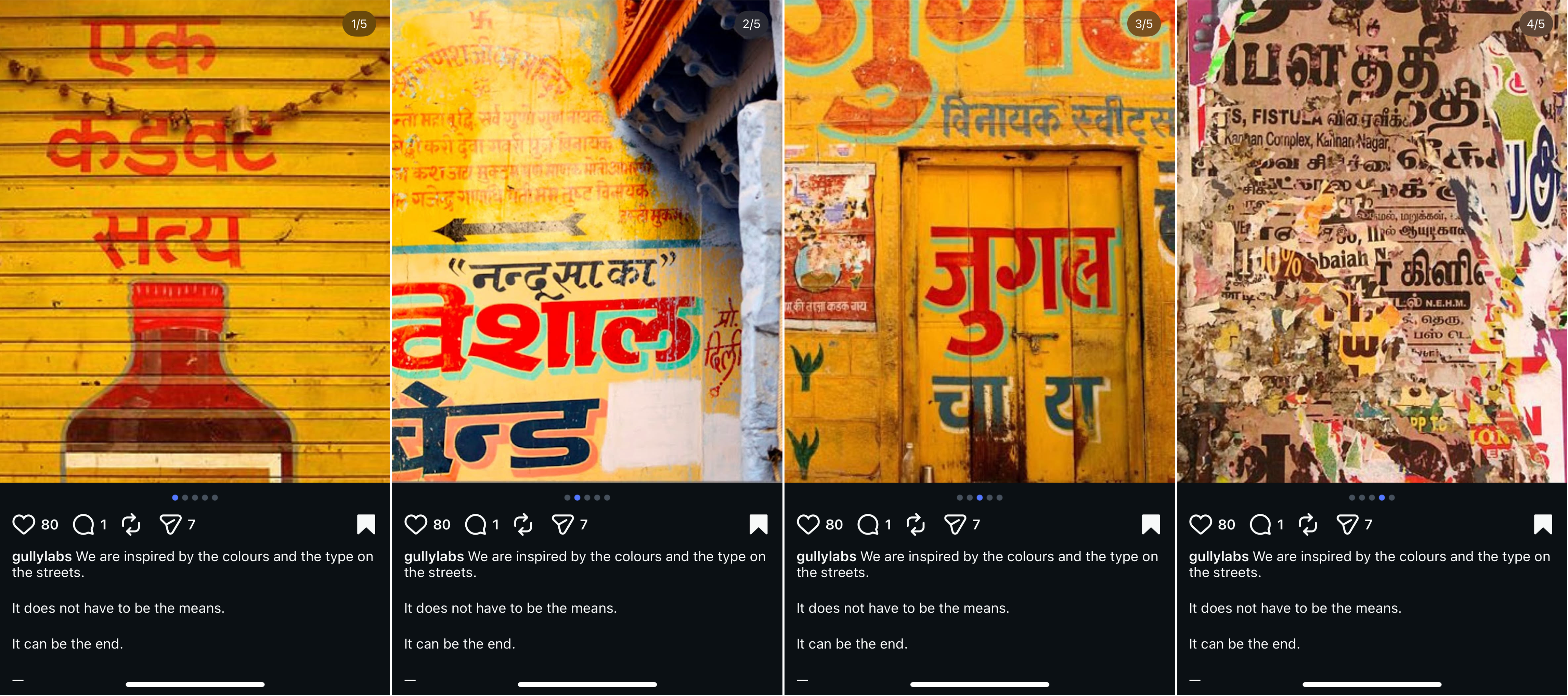
Our challenge was to try and take a fresh approach to this, to create something that felt like it belonged in the India of today. We didn’t want to just plaster a Mughal painting on the side of a sneaker, because that doesn’t make sense to the current generation.
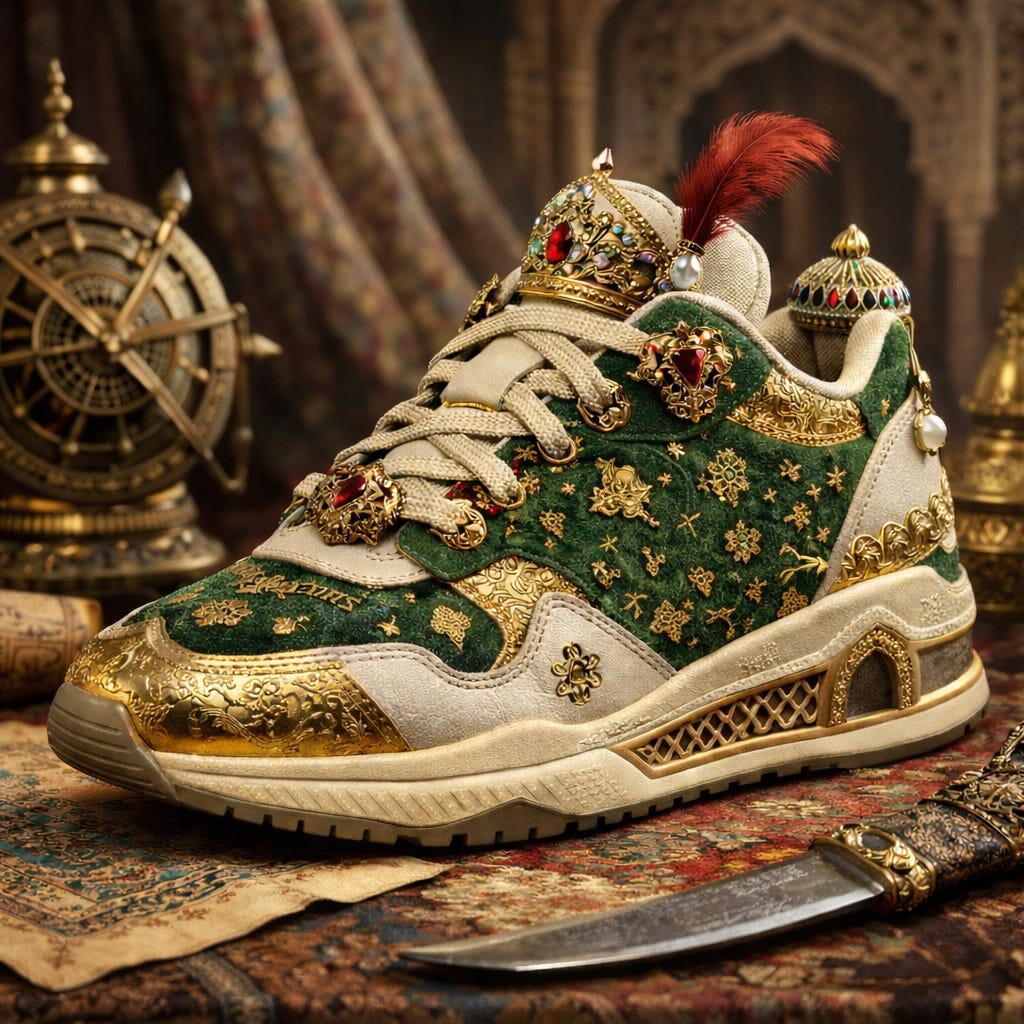
From your POV, what’s the difference between the Indian design philosophy of the past vs what you guys are trying to do?
Indian design was historically always born from constraint. The products that were made here were typically made for a time of scarcity, and a mindset of scarcity too. As a relatively young democracy we’ve historically not always been in control of our economic destiny. It’s meant that most of our decisions, individually and collectively, were made around survival. As a result, items in India were never made to be world class, they were meant to just be functional enough to do the job, which meant, in fact, they were usually sub-standard.
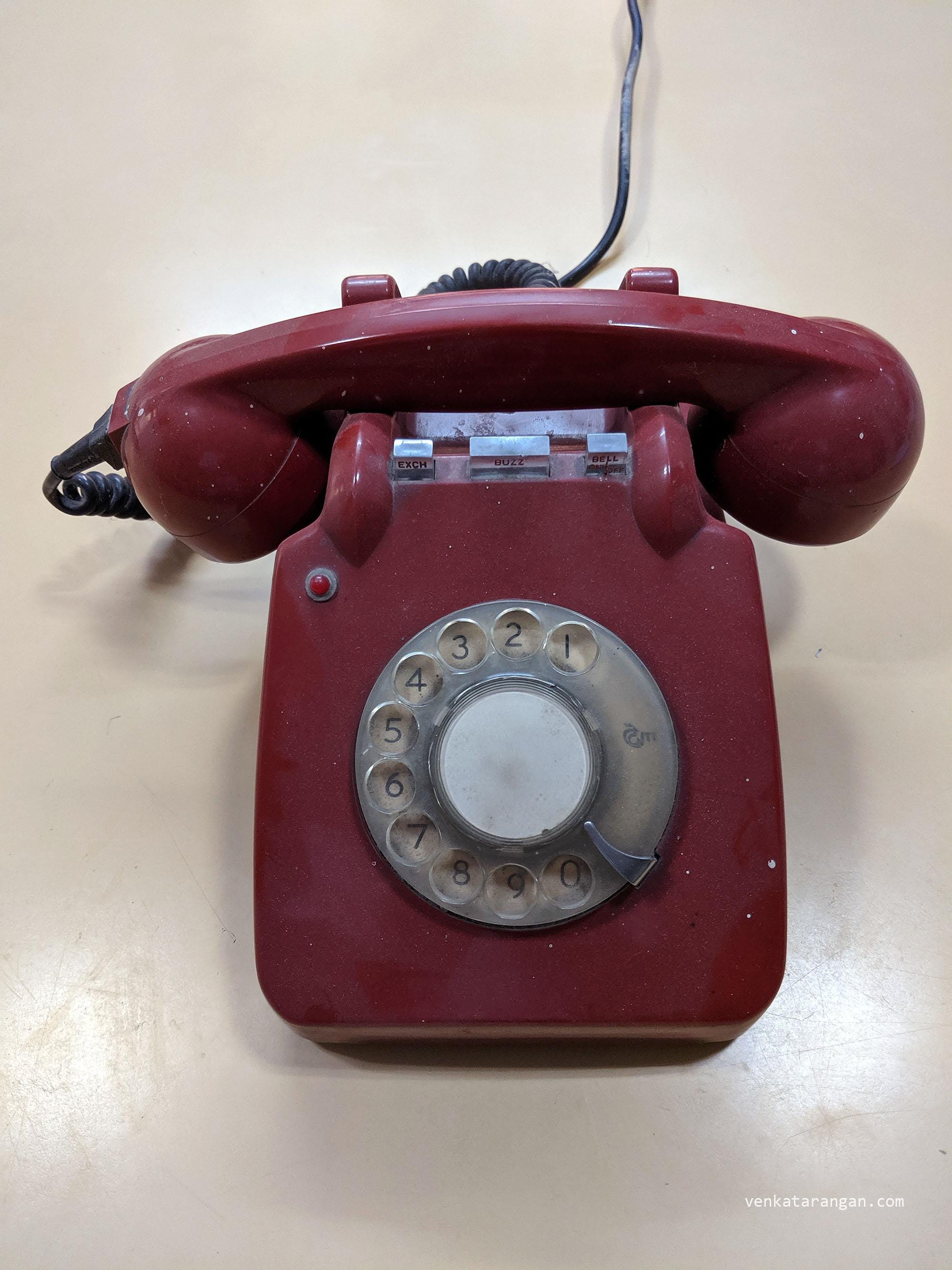
That whole era resulted in ‘Made In India’ becoming associated with ‘compromise’. It’s why ‘Imported’ in India has always had a nicer ring to it. Growing up here you were trained to believe that the thing that came from outside was better than the thing that was made here. Most people didn’t have an option either way. The ability to care about or think about things like good design and aesthetics, or even good quality, was something reserved for only a tiny, rarified strata of society. So it didn’t really make a difference one way or another to the few brands that plied their trade during that era. As an aside, it’s also why the best Indian designers plied their trade mainly for foreign brands - it was the only place where they could express their talents and vision.
Today it’s different. The mindset has changed. We are no longer content to just ‘make do’. Our ambitions and exposure have expanded. All of which means that today we can be bold enough to design from a position of abundance. Brands have the luxury of thinking about the user experience first - from the POV of ‘how should we do this best’ instead of ‘how should we save cost’.
It took us some time to figure out a system that worked for us. We had to create this world from scratch. But at least from a company perspective and what we wanted to achieve, we had a clear vision. What we wanted to do was to take a simple motif or an experience that was very commonly felt and seen in India, but elevate it and make it feel desirable, and like it belonged to this time period.
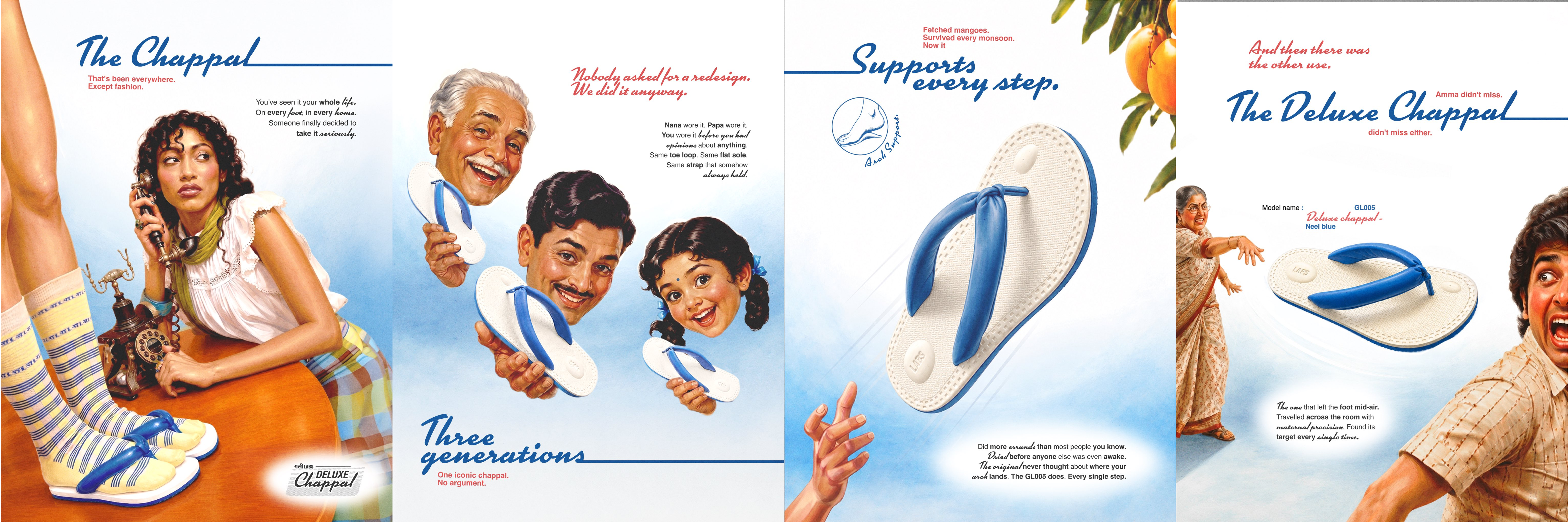
I’ll give you an analogy. A lot of modern bars in India will have a kokum-infused cocktail on their drinks menu. That is a great example of taking an amazing ingredient that is native to India - something that is a part of the everyday cuisine of so many people here - and contemporising it for the 21st century, in a way that millennials and Gen Z’s can appreciate.

It’s kind of what we want to do with sneakers. It’s sort of what Blue Tokai did to battle Starbucks too - leaning into Indian-origin beans and Indian imagery to separate itself from everything else at the time, in a way that felt genuinely novel. So that’s the problem statement we wrestled with for our first collection.
How do you reflect on that first collection now?
I’ll be completely honest - I don’t think our first collection was very design forward or experimental from our side.
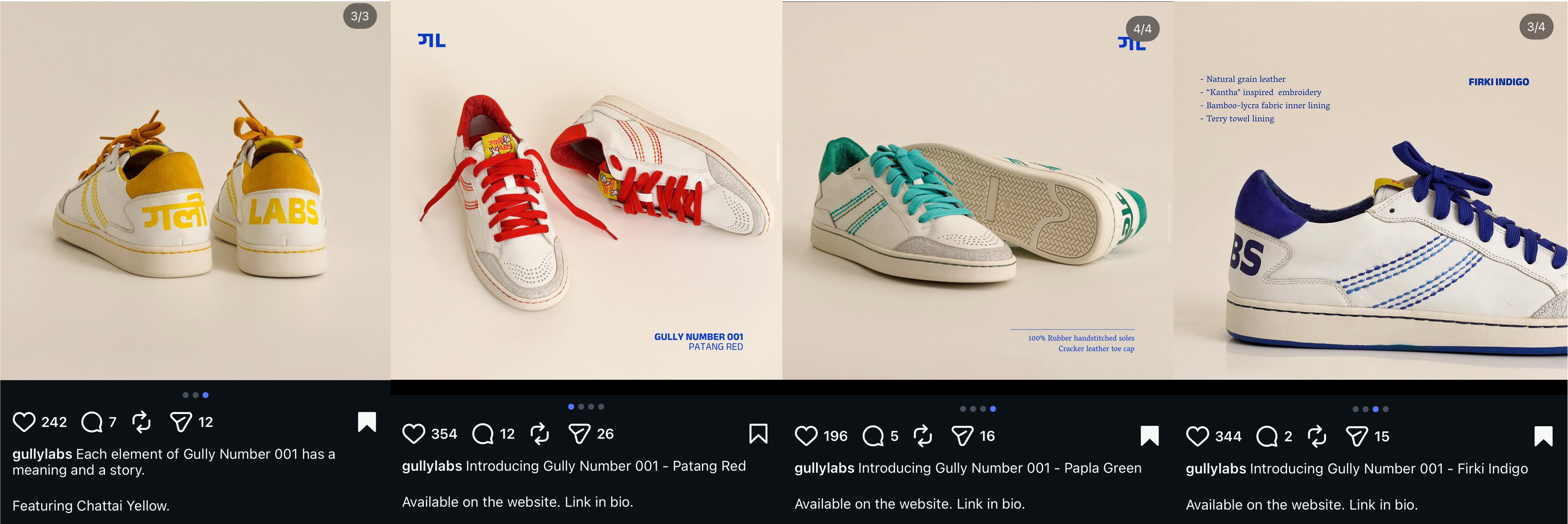
We were more driven by ‘let’s find a silhouette that is nostalgic, that is old school, that reminds us maybe of those campus action days, that unlocks that memory in our minds’. Second, let’s just take a bold step and put Devanagari lettering at the back. We’ve gotten serious flack over that decision, like, ‘hey, this is lazy design’, you just slapped your logo at the back with some Hindi text and called it ‘Indian design’. Yeah we got a lot of that, maybe it was deserved.
Here’s how we rationalised it though. For us, it was more about taking a stance. It was more like a messaging point, that rather than hiding something - i.e. hiding our Indianness - we made a conscious decision to lean in, which naturally drew a lot of polarising reactions.
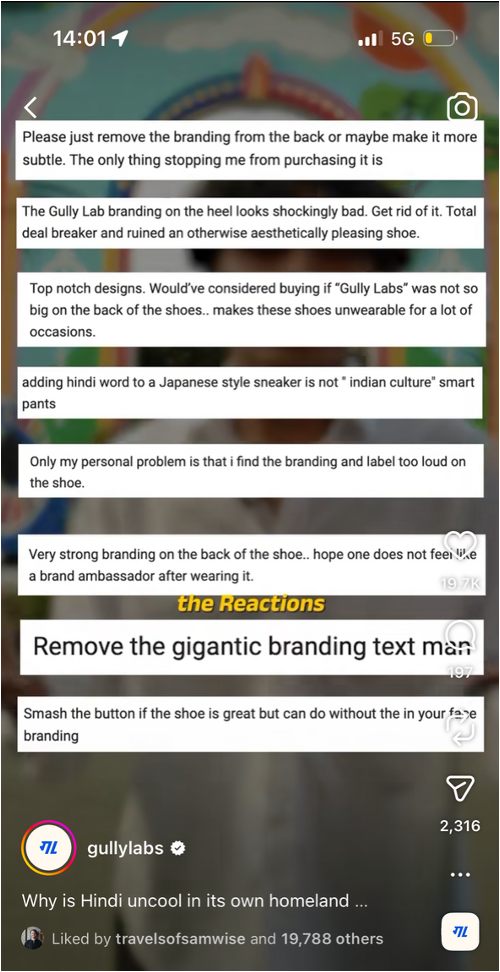
Sure, someone might call it lazy. But which other modern brand aiming at the younger generation has ever taken the stance of - okay, let’s put Devanagari in a massive bold font on a product that is also priced super high. People gave us so much shit over the following weeks and months, but the idea was to take a position. A strong position. And to find people who aligned with that. It was as simple as that.
So I would say these were the two primary design philosophies. The other was that the first sneaker we did had to have an Indian element. In our case we looked towards Kantha embroidery.
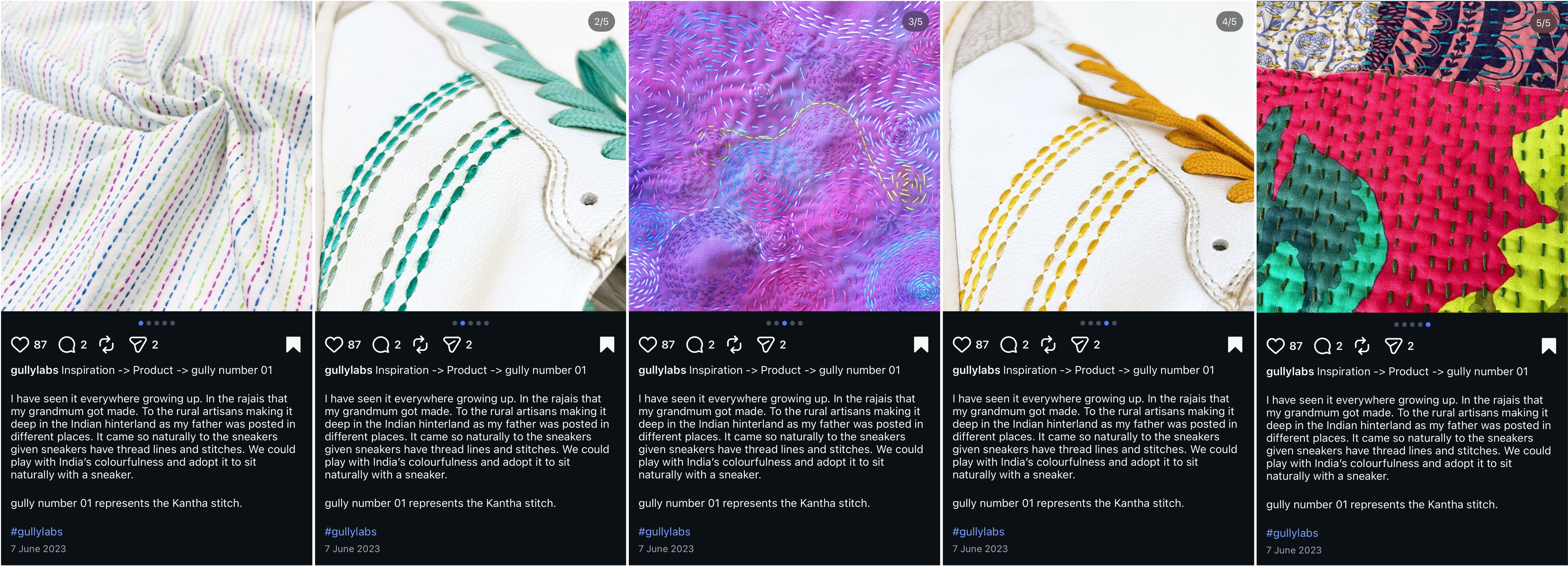
On the whole I would say Gully Number 001 was well received. The flip side was a lot of people felt that it resembled an Adidas Samba, it resembled the three stripes and whatnot. So while I think that was a beautiful shoe, we discontinued it over a while. We would love to bring it back in another shape or form. But that was the story of our first sneaker.
If you had to distil the design principles or rules you’ve developed at Gully Labs now, what would they be? Like if Anshul was briefing a new designer joining the team, what does he tell them about what makes a sneaker a ‘Gully Labs’ sneaker?
I would say there are three general principles we abide by.
One, is that it needs to have India in it. We take inspiration from Indian scripts, Indian fonts, Indian embroidery and surface design techniques, and of course Indian stories.
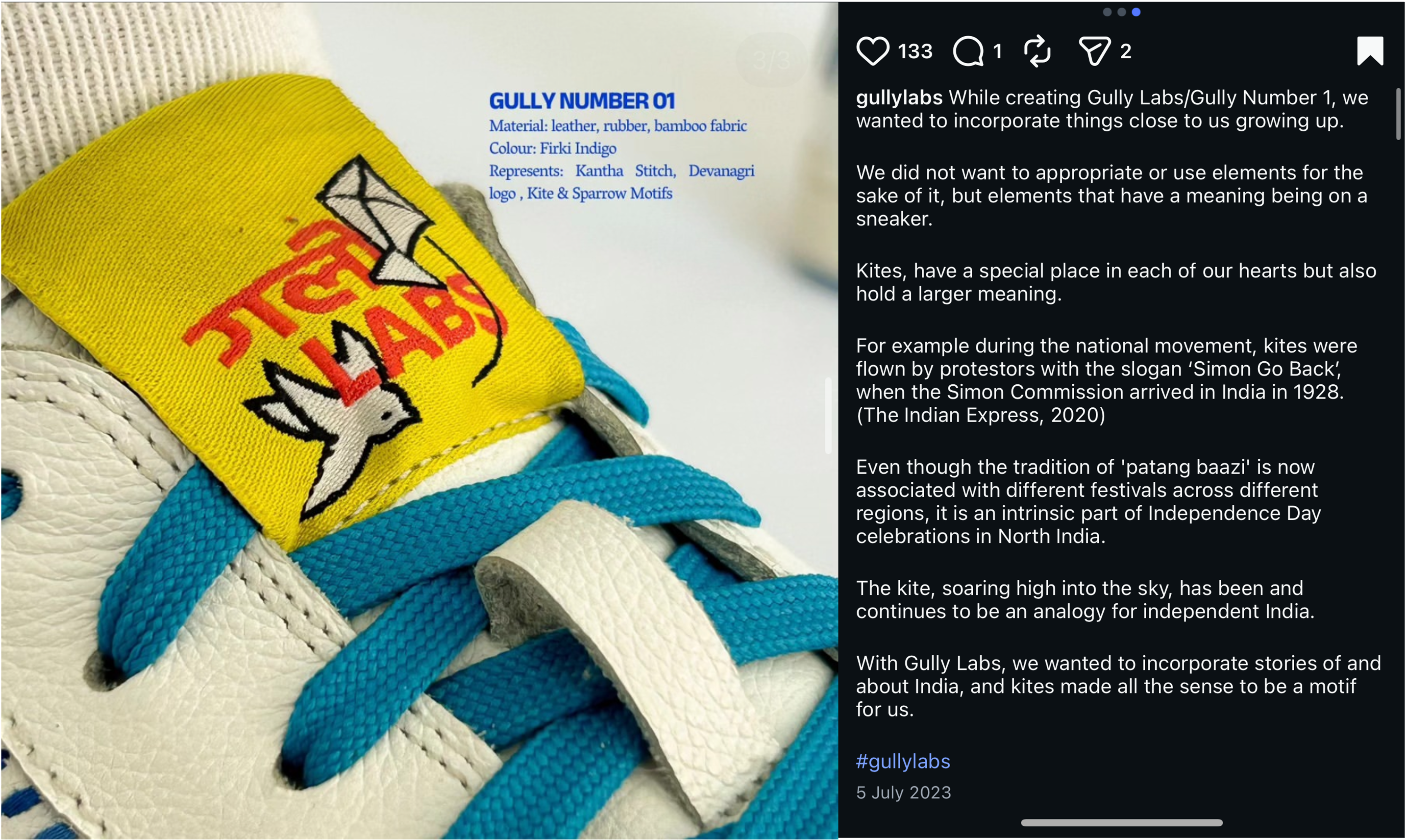
Two, is that this Indianness needs to feel contemporary and aspirational. It can’t be lazy. We wouldn’t just copy the design on the back of a truck, for example. We force ourselves to reimagine these everyday elements in a new context and for a new generation. Subko and Pistabarfi are brands that I think do a terrific job on this front.
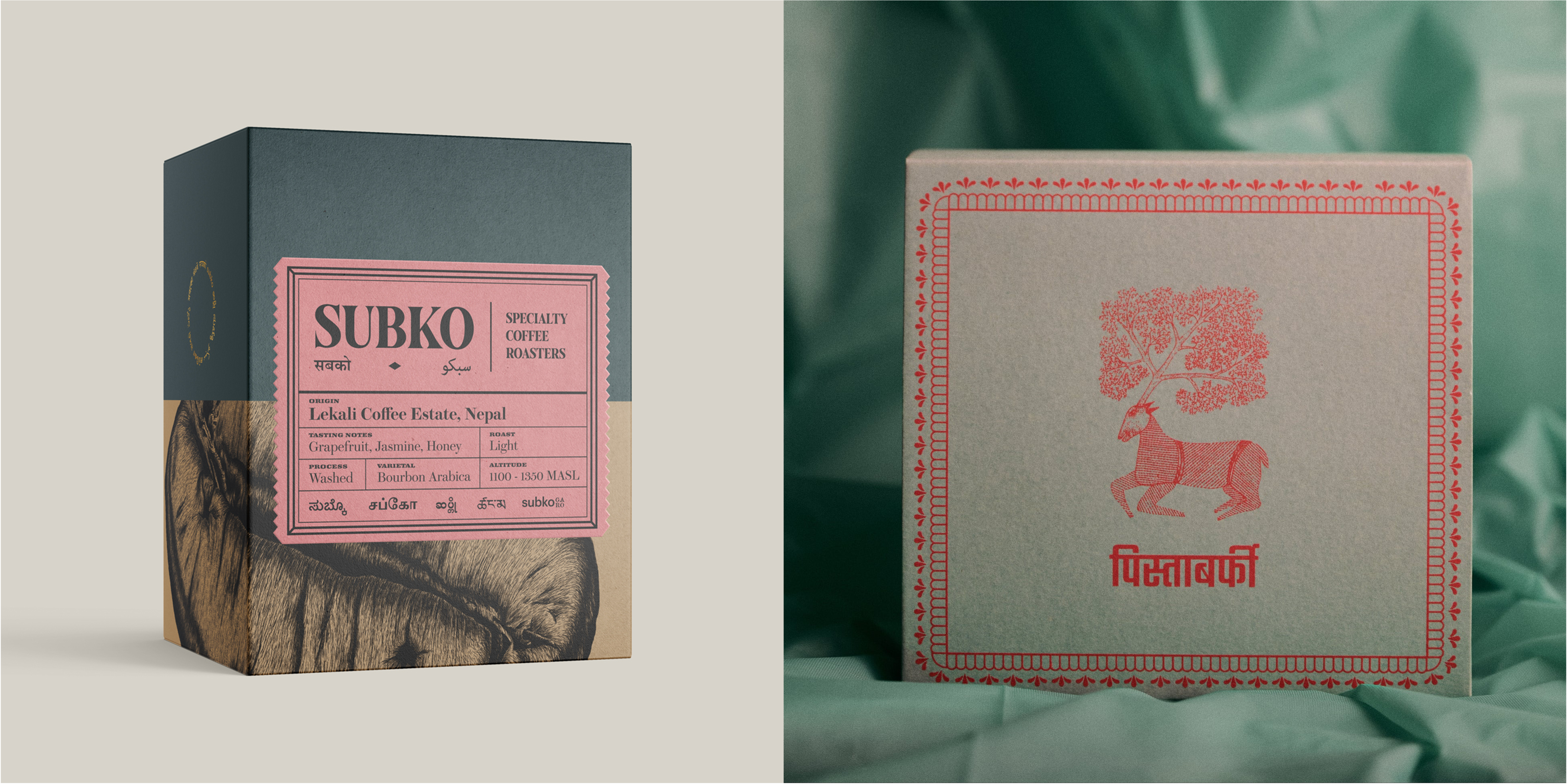
And lastly, it needs to have a strong narrative foundation. Any sneaker or collection that goes out has to be grounded in story. Every material and element and feature must have a reason for being there. It cannot be led by vibes alone, there needs to be a rationale for the design.
For example, our 003 collection was inspired by a jutee and mojari. Why? Because that was the footwear of choice at one point of time in India. So we were like how do we reinvent or reimagine that as a sneaker? At the same time, we know that racing sneakers were coming into vogue again - your Pumas and Onitsukas etc. To us that flatter silhouette seemed like it would lend itself to being a good base for a reimagined jutee or a mojari.
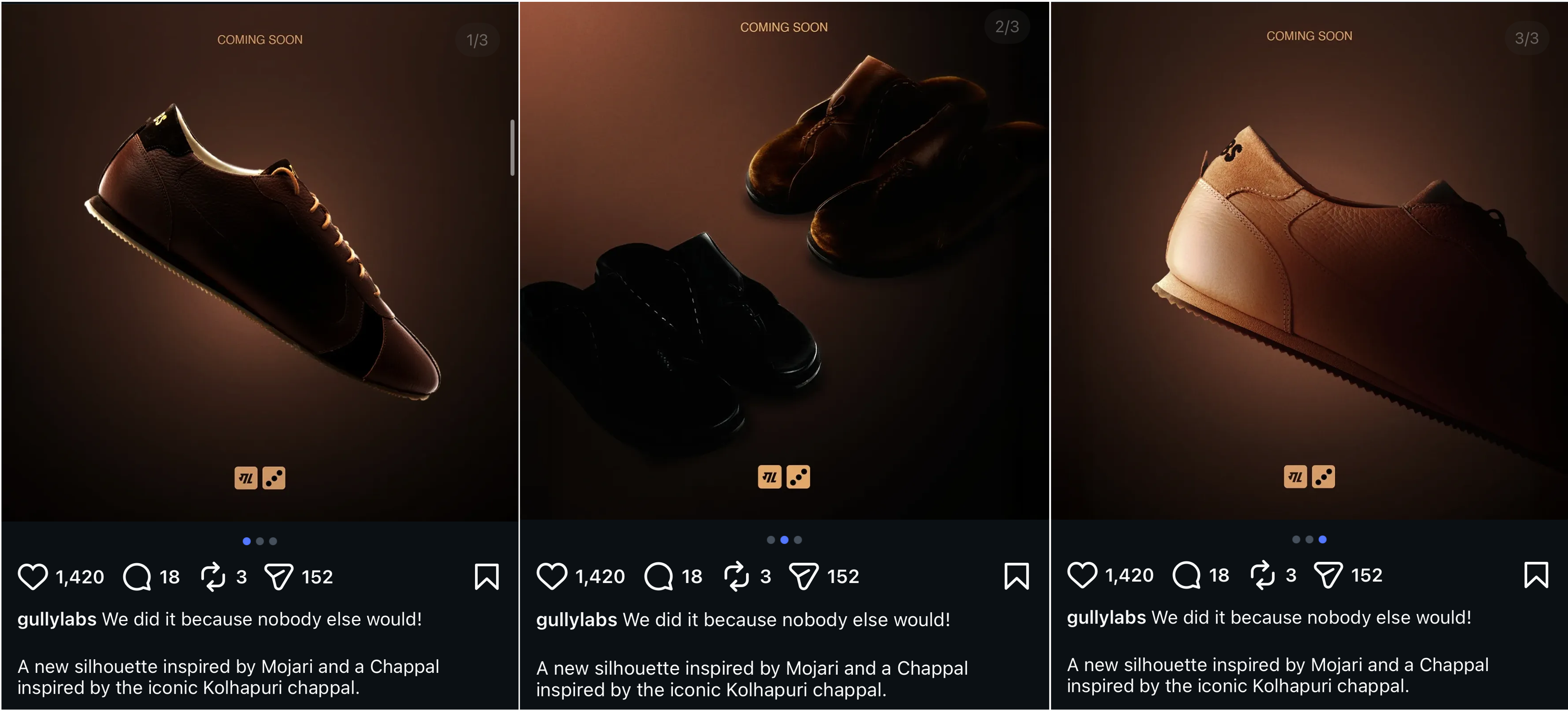
That was the starting point, and then we kept iterating on it. To do that though, you need to have a deep understanding of the anatomy of a sneaker. Because what you don’t want is to make a Jutee Sneaker, that’s neither here nor there. What you want is a sneaker inspired by a jutee, which requires more thoughtfulness and creativity. Those are the types of conversations we keep having when working on a new collection.
So to sum up, for any Gully Labs design - the word ‘Indian’ is important (strong sense of identity), the word contemporary is important (go deep into research so the replication doesn’t seem lazy or tokenistic), and the word narrative is important (we want to make timeless pieces which tell a story - everything must be intentional). It’s important that the final design itself tells that story too, not just the marketing or content.
You guys have an interesting approach to naming your sneaker collections too - what’s the thinking behind that?
Have you been to an Ikea store? If you’ve looked at all the product names there, they’re all Scandinavian or Swedish. You can’t even pronounce 90% of them. Still people lap it up. The company didn’t feel any need to change it or dumb it down. They just called it what it was and kept going.
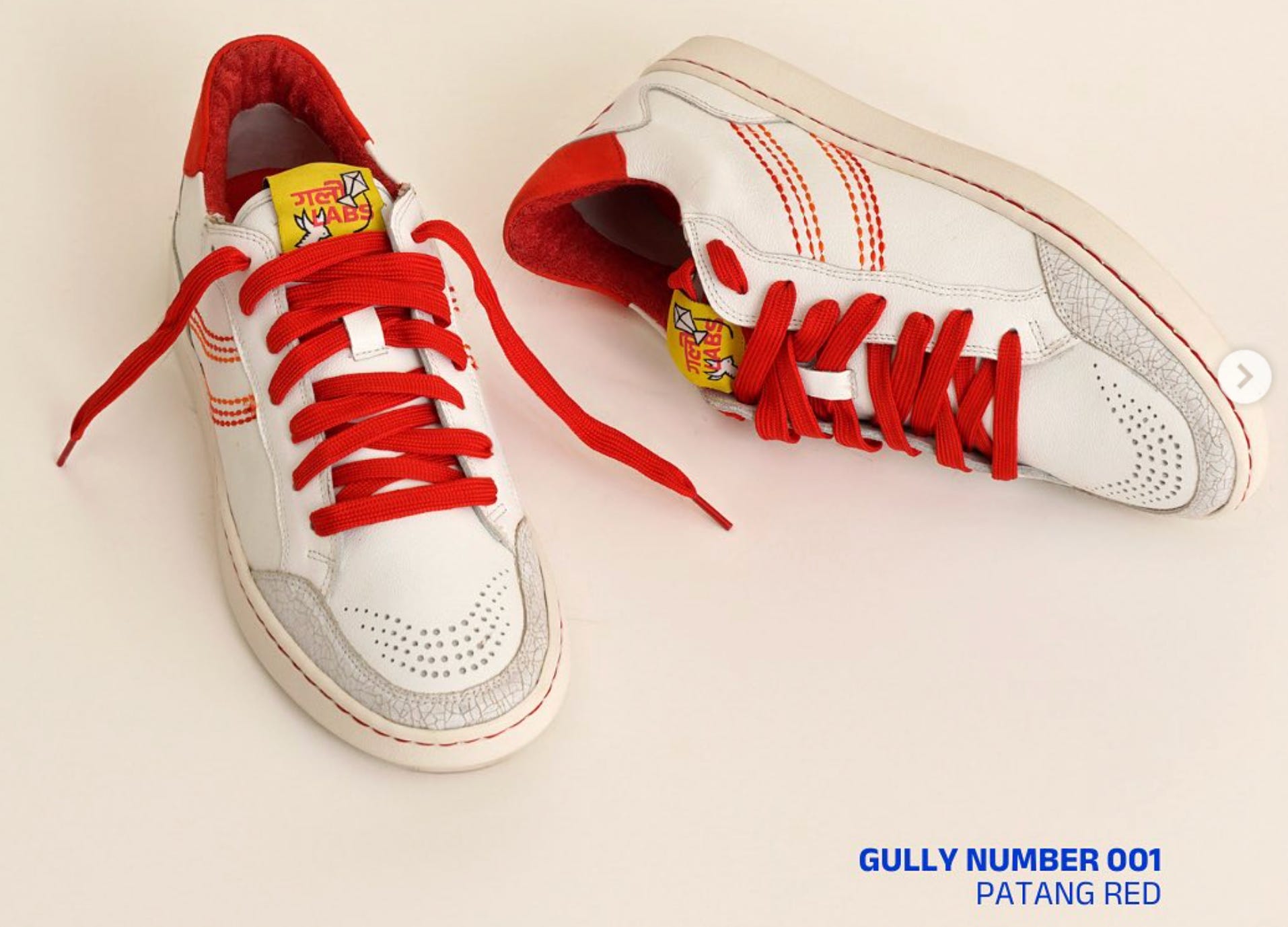
We were very inspired by that. And therefore all our sneakers have an element of things that we grew up with. The first yellow sneaker was called Chhatai Yellow, because, you know, chhatais are yellow. And it’s that same shade. The red version in our first collection was called Patang Red. If I say Patang Red to anyone in India, even if it’s south India, they will get the reference.
We’ve continued that naming convention very consistently. Even the Kulfi collection - Rabri, Badam, Pista, Kesar. If I say these words, you know exactly what I’m talking about. Your brain produces those hues. You know the exact shade.
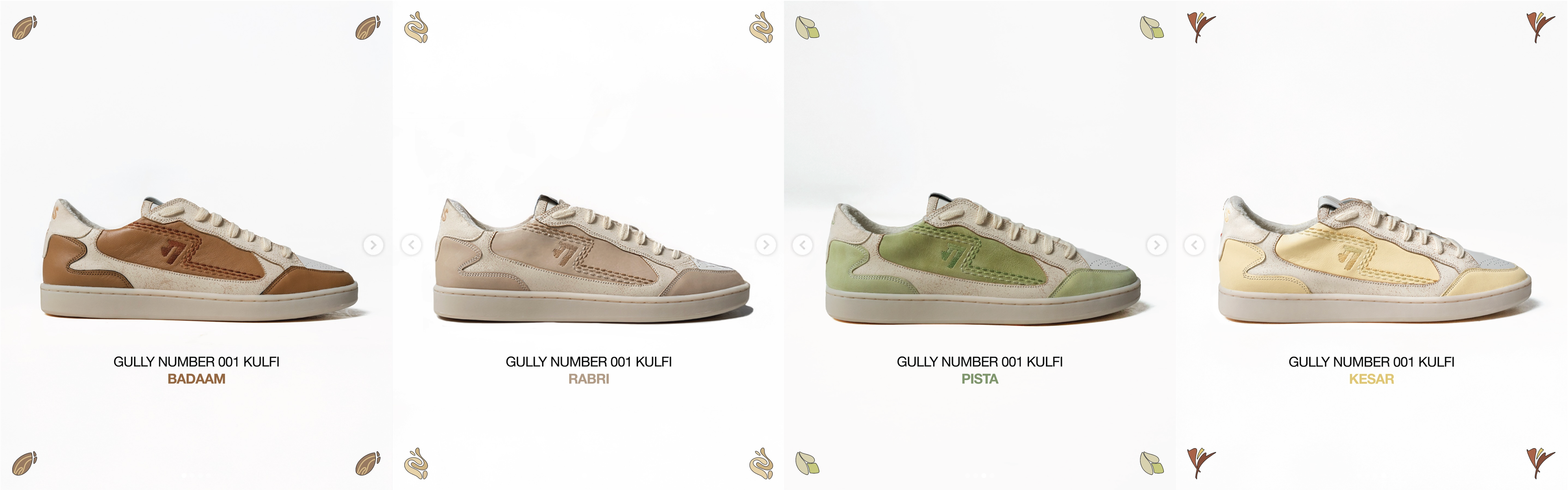
For a sneaker company from India, we couldn’t not name our sneakers with these conventions. It’s what made us different.
Are there specific design details in the shoes that most people would never notice but have a cool story behind them?
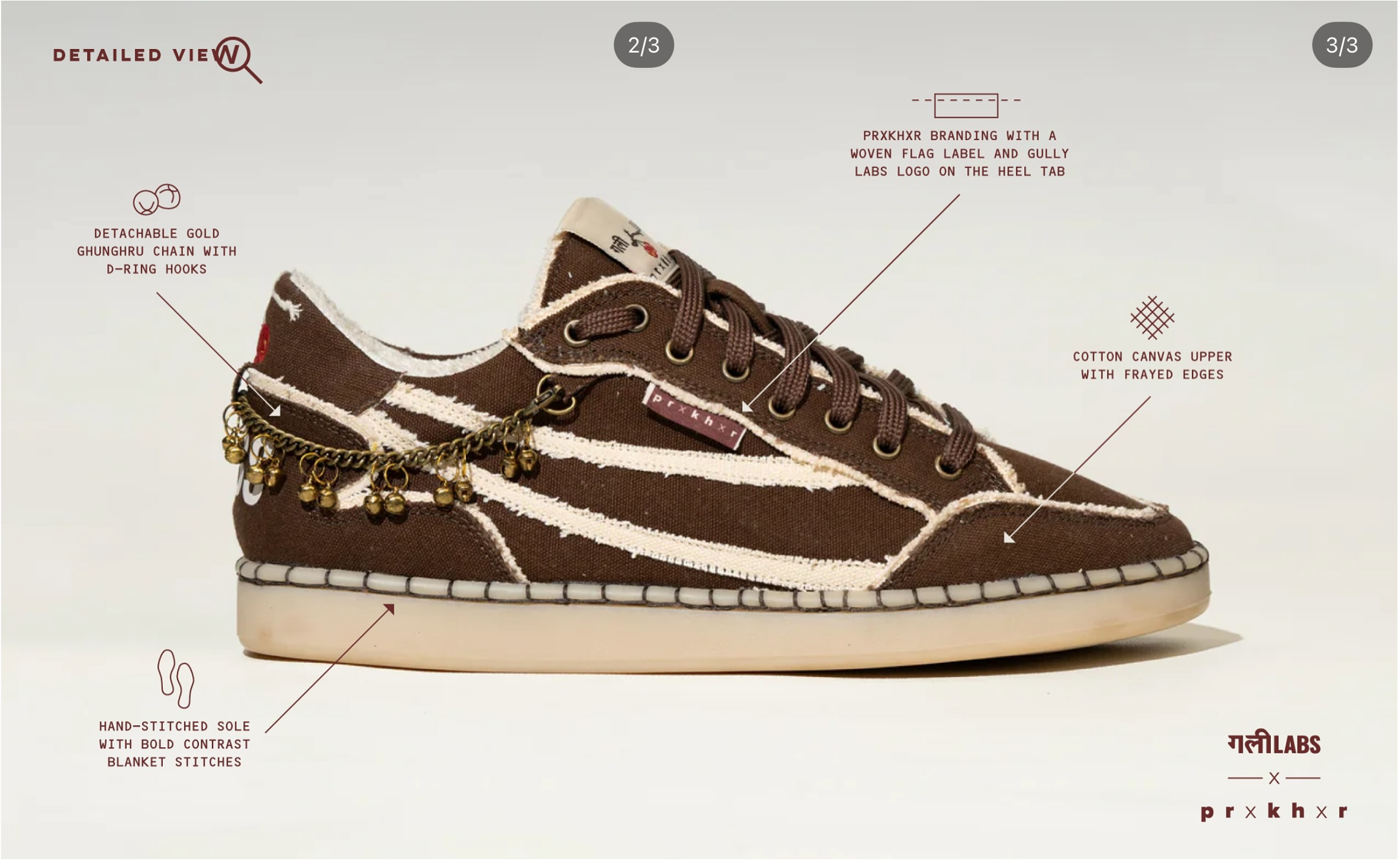
The perforations in the toe of our sneakers was inspired by Rangoli patterns. Unsurprisingly it’s very unique to us out of all sneaker companies in the world. We also hung a ghungroo on one of our shoes - that I can’t imagine anyone else doing - because it’s associated with Indian dance forms in so many ways.
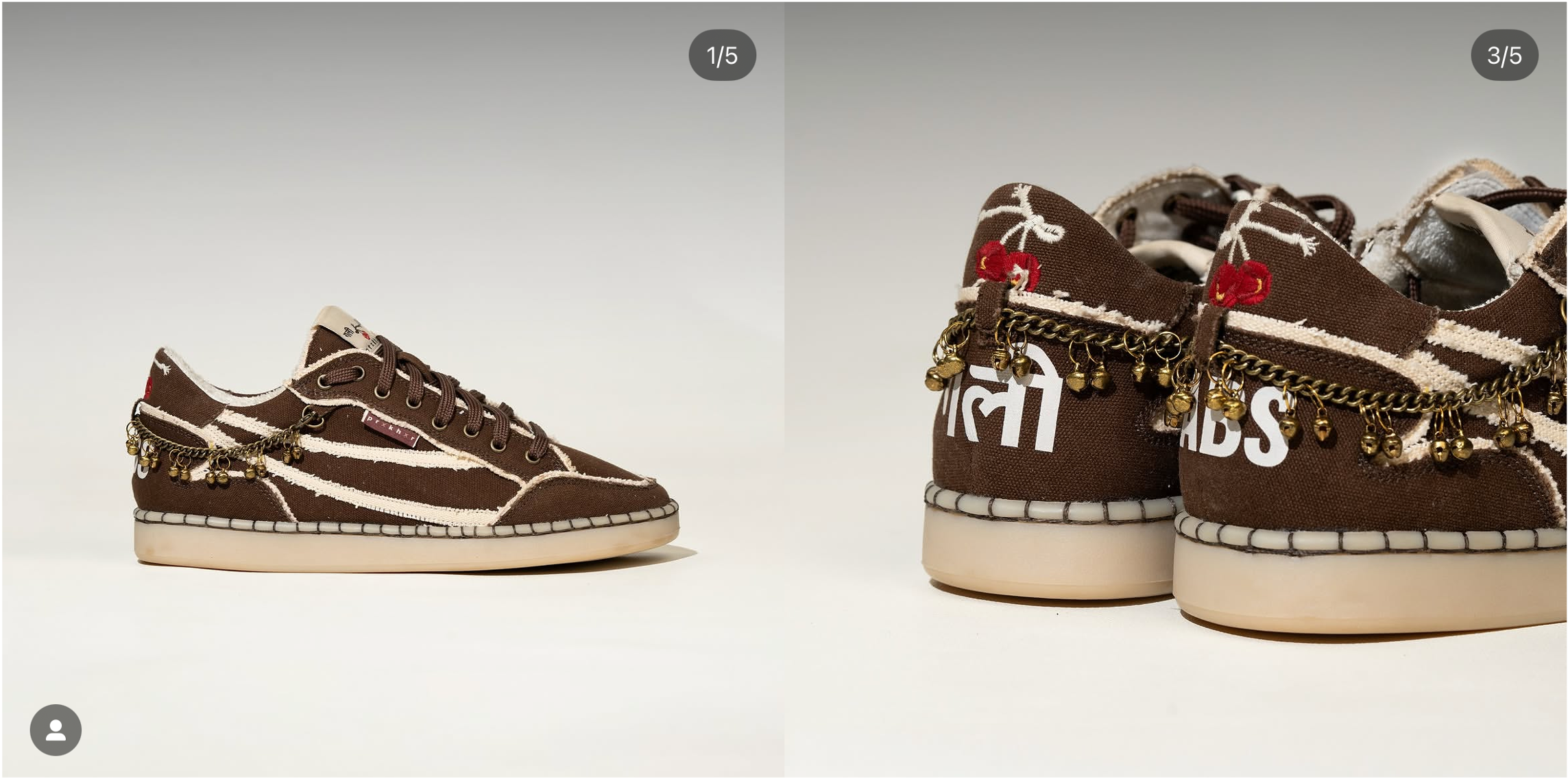
These are the small traditional elements we add to make our collections stand out, but the silhouette by itself needs to look contemporary and modern.
Can you walk me through what a typical design process would look like end to end?
I will preface this by saying that our process is our process - it’s something we figured out on the go, and something we will always continue to refine. It all starts with an idea - sometimes it’s a story, sometimes it’s a festival or occasion, sometimes it’s a bit of news, sometimes it’s a memory. Sometimes it’s opinions we have as a company that we want to express. Many times ideas come from our customers, and even from our past portfolio. It could be a colourway, or a style, or even a use case. All of those disparate elements sort of mash together to produce our product roadmap. Once we have that, everything else comes into focus.
For instance, for our hockey collection, we always knew we wanted to do a vintage runner silhouette at some point because that’s a classic shoe that we didn’t have in our stable. Then for the previous year we had become infatuated with the lore of the Indian hockey team - the fact that it was historically dominant and reached the kinds of stature in global sports that not many of our sports teams have managed. But it had never been properly venerated in mainstream discourse. It felt like we had an open canvas to to tell that story.
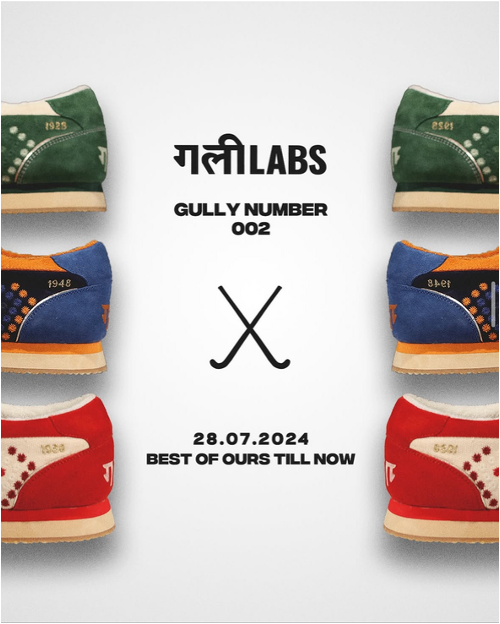
Once we had that idea, Anshul takes that brief - which may be in words, symbols, or stories - and starts prototyping. The silhouette of that shoe was relatively easy and more standard in shape. So the journey from 0-85% is relatively straightforward. The journey to 99% is usually the harder part, which in this case was cracking the motif panel on the side. It took us two weeks to get that right. We took inspiration from Phulkari, which is a traditional embroidery style from Punjab, the stronghold of Indian hockey.
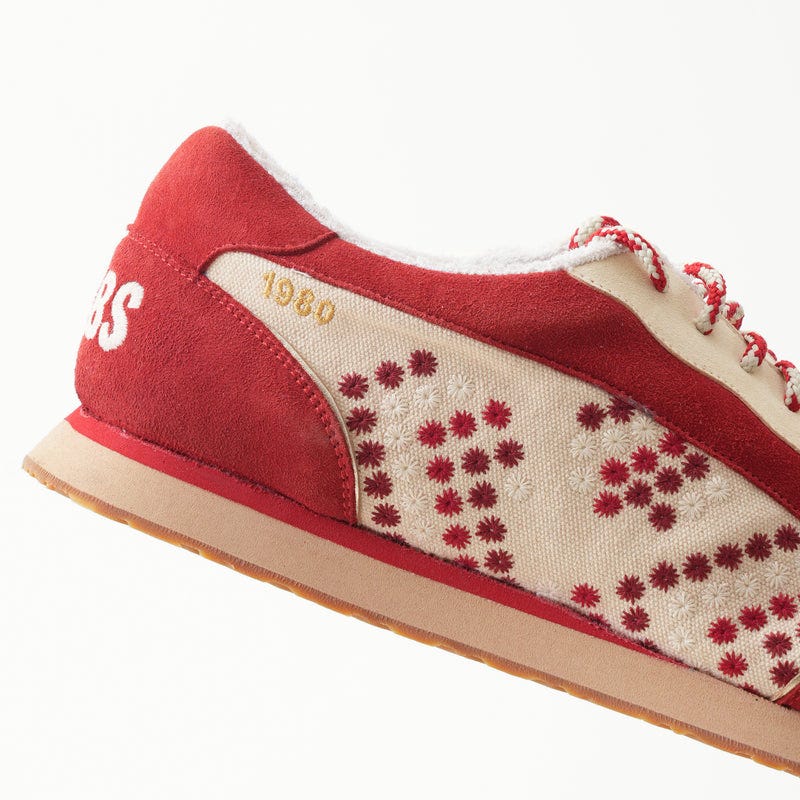
Everything starts with a sketch. We try and ensure that the sketches bear resemblance to the look and feel of the materials we want to use. Then it goes into the sampling and rendering process. From the 3D render, you can get a good sense of ‘hey, does this look right or not?’ And then from that you get to the actual first prototype, which is when you start seeing how it looks in real life, does it require major changes etc. Once that is done it goes into production. A new silhouette or design can take anywhere from two weeks to six to eight weeks to finalise.
Then we’re always thinking about how to take our efforts to the next level of originality. We never want to be accused of copy-pasting. So with this collection, that meant uplifting the packaging and box too. We put a custom gold medal as a collectible in the box, like the kind you’d get winning the 100 metre race in school. There were also small cards with the hockey turf layout and Major Dhyan Chand in an animated version at the back. We even had the Vice Captain Hardik Rai visit our factory. It served as a reminder to us that - as we put together these collections - it’s important to pause and reflect on why this collection exists at all.
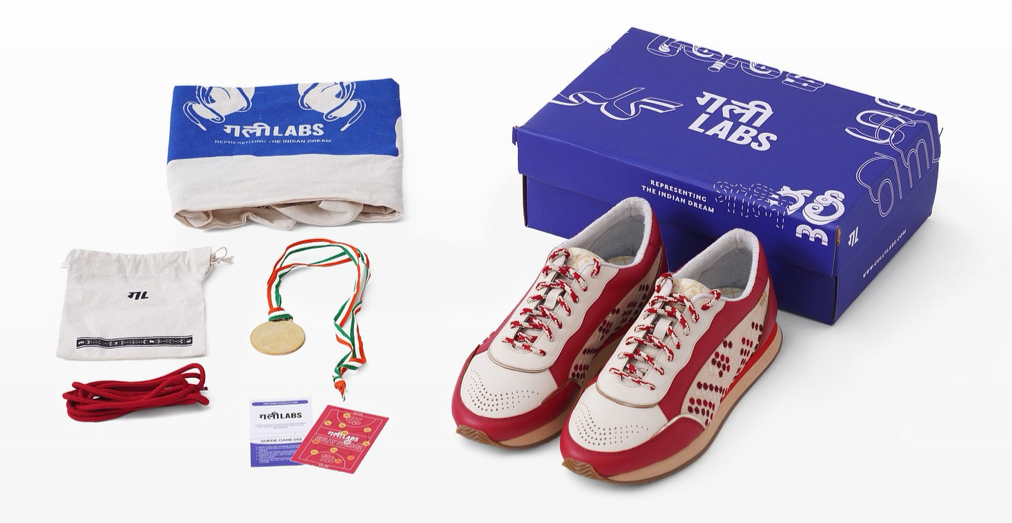
So that’s the kind of thing that goes into our process. You keep pushing forward till your gut tells you it’s done. We like to take risks by doing something original. The downside is that sometimes people don’t like it - that happens. The upside is that if you get it right, now you have something new and unique that is tied to you, that you can further adapt and scale. All our best shoes have an element of that.
What’s been the biggest design miss so far?
So there are probably three kinds of results that we’ve become accustomed to seeing. One is when we expect something to work out well that then works out well. The second is something that we expect to work well that doesn’t work out. And the last is something that we don’t expect to work out that well that works out super well. That’s the matrix.
We have had sneakers that we thought were too experimental and will not sell a lot that have been bestsellers and haven’t stopped selling to date. Then there are others that, upon reflecting, we have realised that we should not have put out. It’s usually something that we felt was only partially ready but for some reason still put it out, that in hindsight, we had no business of putting out, and which logically resulted in deserved failure. Those are the ones that we need to really stamp out. For things that we were confident about that did not work out, we’re kind of happy because at the end of the day we stayed true to ourselves.
But it’s the products where we were on the fence or we were not really happy about in our hearts and minds - when that doesn’t work out, that is for us to reflect on. Did we not work hard enough? Did we not understand the product ourselves? Did we misread the market or the customer? Was there something obviously off that we realised after getting customer feedback? And could we learn from those mistakes to generate a future win.
The Baaz collection was an example. We launched it in three colours and realised that all three just did not land properly.
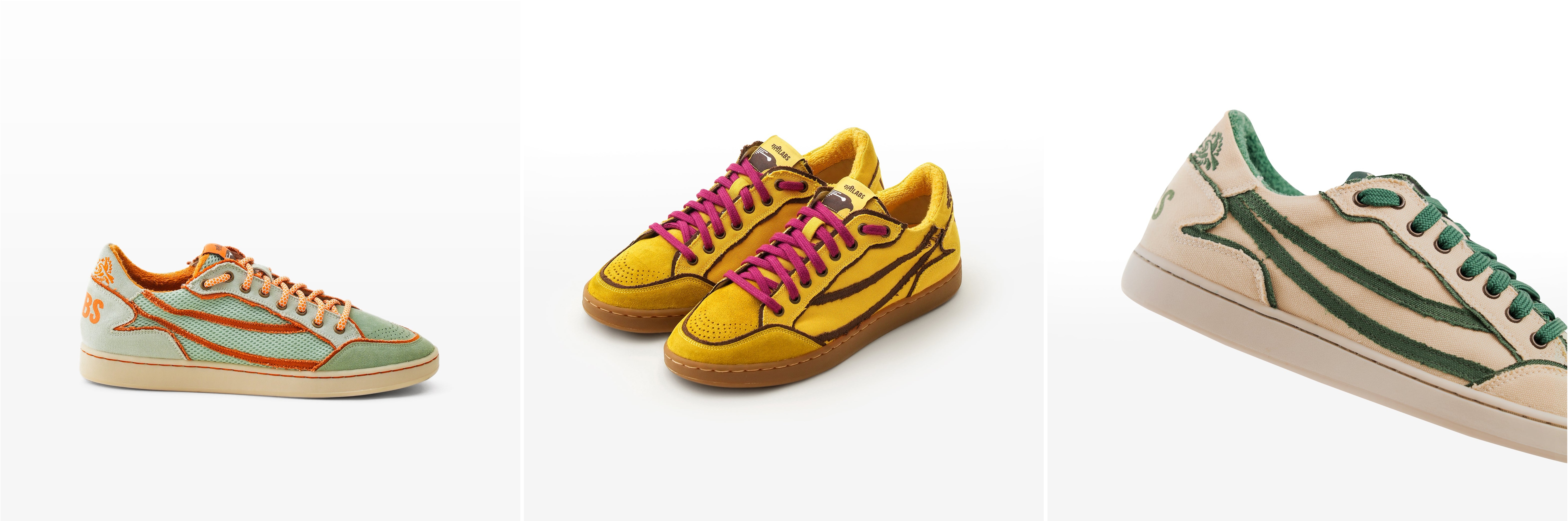
While the concept was there, the price was there, the shape was there, it just wasn’t clicking with the audience. So we took an instant decision - let’s put out a black colourway. We don’t have a black silhouette. This is a very classic shape and form, and this has been missing.
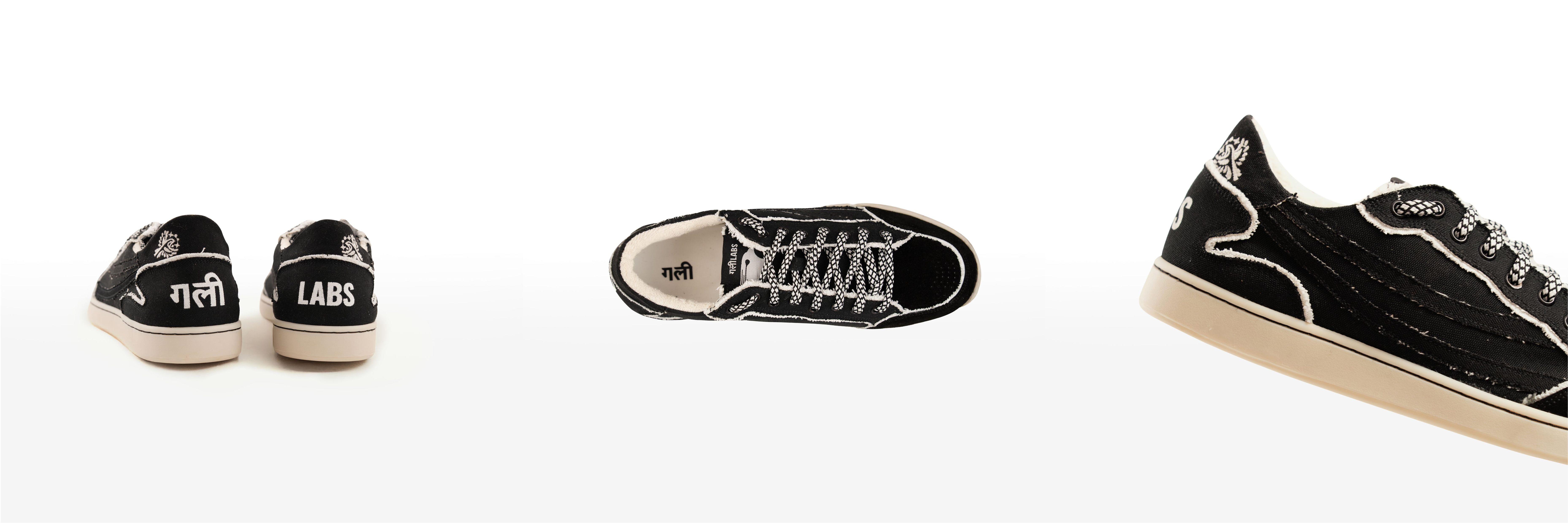
And once we launched that, it instantly became a hit. Within 14-20 days it was a bestseller. And the black colourway actually pushed the entire collection forward - all the other shoes started selling too.
That gave us an insight - there are some products and things that people enjoy looking at, and there’s some products and things that people actually buy. In India, people (and our audience in particular) buy a lot of black and white, which now reflects in our portfolio. For a certain section of consumers, a lot of the design-forward and bold-coloured shoes are nice to look at (on Instagram etc), but this crowd tends to be a bit more conservative when it comes to their actual purchase decisions. Like, our heater products are the Calico White, Barfi Burgundy, Turf Olive, Baaz Forest Black and Baaz Purni White - relatively tame colours. We now try to incorporate that thesis in every single collection.
VI. THE FACTORY — Manufacturing from Nothing
Can you take us back to the first week of manufacturing. What did that first facility look like? How did it even come together?
It was pretty much an empty box, a bare shell. There was nothing inside it. It was one floor of a building in Noida - a 1500 square feet area which used to house a bag factory previously.
We knew that this space could get our production started relatively quickly in a very small scale. We had found Anshul, who had experience with product merchandising. He took ownership of managing the entire unit, helping us source karigars and machinery and what not. He sourced the first five karigars from his network, and then worked with the senior-most one find the right vendors for equipment, machinery etc. Something that may come as a surprise is that there are only three or four vendors for shoe-making machines in India, the kinds we needed. India doesn’t make any of these itself - all of this is imported from China and rebranded under local names. It tells you about the extent of the knowledge gap we still have. So we bought three or four stitching machines and a couple of other ones, and that was enough to get the ball rolling.
Because we had only raised ₹1.1 cr in total, we had to set up the whole factory in under ₹10-15 lakh. That was the budget. The first month everyone got training from Anshul. We had our karigars iterate with fake leather samples so that they could understand how the shoes are made. No one knew if this was gonna work or not. But we were confident that we could crack it.
And in that whole first proper year of operations - this is 2024 - we never really went beyond 15-16 karigars in totality in that building regardless of what the monthly demand was. People kept telling us that we should be outsourcing our manufacturing, that this was a waste of effort. But we didn’t have tons of cash in our bank. From our POV, from a time and cost and iteration perspective, we couldn’t afford to set up any other way. Look at China - one of the reasons they make good products is because the supply chain is so integrated. We think having a faster feedback loop gives us a significant long term advantage, even though it took more time to get going.
You guys have obviously levelled up since then. I believe you have a 10,000 sq ft facility now. How many people and roles does the operation involve today?
There are about 110-120 people involved in manufacturing now. Lots of new roles - there is a floor manager, there is a QC person, there is an inspection guy, inverting, outverting, all sorts of roles imaginable. That’s apart from the karigars of course. Now we have different karigars operating different machines.
Our maximum capacity right now is about 8,000 sneakers a month, and we’re currently utilising about 50-60% of that potential. This facility manages the entire production process - sourcing raw materials, developing patterns and moulds, all the way through to finished product.
On your website you say that Gully Labs makes “hand-lasted” sneakers collections. What does that mean exactly?
So first, a quick 101 on how a sneaker is actually constructed. A sneaker has two main parts - the upper, which is everything on top that wraps around your foot, and the sole, which is everything on the bottom. The question is how you attach them together. That’s where lasting comes in.
There are two kinds of ways of making shoes. One is how shoe making started, which is the traditional method, called hand lasting. You take the upper and you have a last - the last is the 3D mould that gives the shoe its shape (think of it like a foot-shaped block of wood or plastic that the shoe is built around). The upper has about 10-15% extra material as tolerance (i.e. extra fabric or leather beyond what’s needed, so it can be pulled tight and shaped). You pull that upper over the last, paste it manually using gum and nails and wait for that to solidify. Then you pull out the nails, buff out (sand down) and rough out the bottom and then attach the sole. This is the most classical way of making shoes.
What makes it interesting is the karigar’s role. Because the process is manual, the karigar can analyse every shoe individually to ensure the symmetry and the proportions match. They can look out for subjectivities and align and shape the shoe properly. In practice, the karigar takes each piece of fabric or leather, pulls it on the sneaker, attaches it with a bunch of different nails at the bottom, heats it, sticks it, then takes off the nails and then smooths the bottom. That’s how each sneaker is done. There’s a lot of craftsmanship involved. Each pair gets individual care and attention - it’s almost like a bespoke process at scale. For context, one of our karigars can make about 2-3 shoes in a day. So you’re looking at roughly 4-5 hours of work just for the upper on the more detailed designs. And that’s with experience - some of our karigars have 18 years of experience in shoemaking.
That’s hand lasting. Then there’s the modern method, called strobel lasting which is what most of the industry uses now. You just simply take the upper, which is cut exactly to the shape of the sole, and stitch or stick it directly on to a piece of fabric or an insole (the inner cushion your foot sits on) and then attach the sole (using something called a strobel machine). It’s much faster - much higher speed and frequency - but it does not leave any room for subjectivity. It is mechanical and does not allow any room where the karigar can adjust things. What you cut is what you get.

The global footwear industry has moved to strobel-made sneakers for the most part. The hand-lasted shoes are mostly high-end, luxury ateliers - expensive leather shoes, formals, boots, and maybe Italian shoemakers. To put it in context - if you consider brands like Axel Arigato, or Golden Goose, or Common Projects - they’re all making sneakers at $300, $400, $500, $600 made this way. We are making that variety of shoe at below a $100 price, which puts things in perspective.
The ironic part is that for us, it wasn’t a luxury decision. It was a constraint decision. We didn’t have budgets to buy the strobel machine or to train our entire range on precision product making. We didn’t want to bet all our capital on meeting the minimum order quantity from some unknown contract manufacturer that may or may not turn out to be good. All we had was five to ten karigars. The only way out was to do it ourselves. So we went to the old school way of manufacturing sneakers and turned that constraint into our advantage.
Now, as the scale has grown, we use both processes. Strobel is used for the sneakers that are priced lower (we can get it at an affordable price to the majority of people). Whereas the more expensive ones are still hand-lasted to preserve that quality.
How do you actually recruit karigars? Is there a pipeline of young people learning this craft?
It’s quite big actually. India is the second largest footwear producer in the world. So a lot of this craft you’ll find being practiced in a few common catchment areas. If you look at Agra and all the villages around Agra, there are many families and individuals involved in the shoe trade and craft.
Because we’re based in this area, we’re fortunate. There’s an extensive talent pool here because of the factories in places like Delhi, Noida…Bahadurgarh is a hub for shoe making. You’ll also find similar points in Tamil Nadu, where a lot of India’s shoes are being made. Or areas like Kanpur, where a lot of leather work is done. These hubs have been operating for decades. People learn over time and pass on this knowledge.
And once you start getting a few people in - not really a LinkedIn type of game - word of mouth spreads because people involved in this trade are constantly talking to one other. Companies that are doing well, they start having their reputation as good places to work. That’s how we recruit our partners.
I’ve heard you describe your karigars as partners before too. What’s that working relationship like? How closely are they involved in the design process?
They’re involved in everything, to be honest. And they’re a big part of our success, and of what makes Gully Labs, Gully Labs. In a lot of other factories, karigars are far removed from the brand and the final output. In our case, their input is sought on everything from story to design to sampling and prototyping. It’s not a one-way conversation. We put them front and centre on our website, and in our flagship store in Delhi too, where customers can see the work and detail that goes into each shoe.
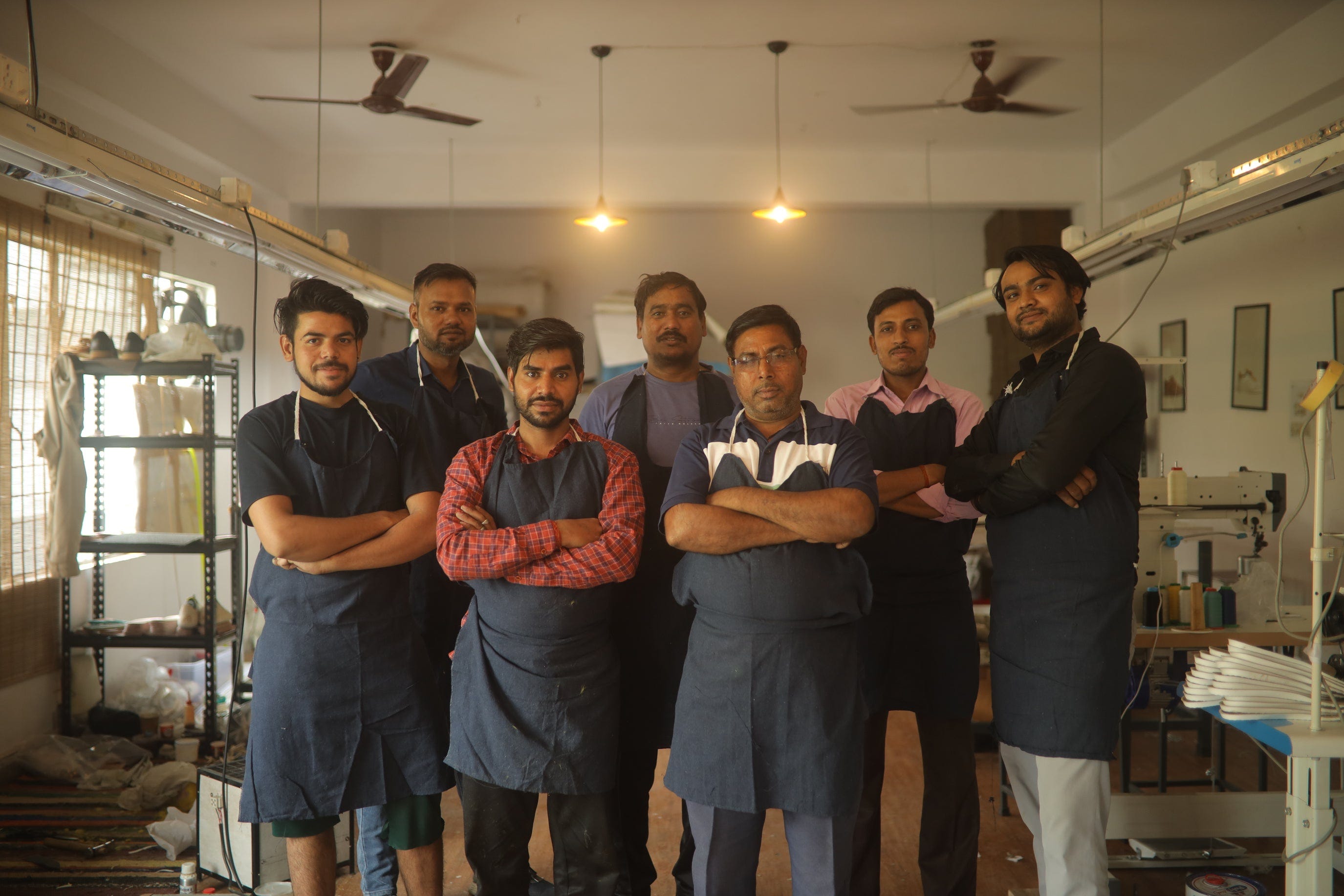
From an employer-employee perspective, their common gripes with other factory-owners is not getting paid on time, not getting advances on their salary, not being entitled to overtime, not getting Diwali bonuses - that kind of thing. We make sure to do all of that plus providing them with insurance and other healthcare benefits. We also give them a pathway to grow along with the company. We think we’ve been able to earn a good reputation on the back of our workplace practices that has helped us become a place that skilled craftsman want to work at.
What’s the hardest part of making a sneaker that most people would never guess?
Easy answer - it’s the supply chain, especially in India. In this country you will live or die by the quality of your supply chain, and your ability to ramp up and ramp down as required.
The overall working culture can be a challenge to work with. Especially when you are starting small, you don’t have much leverage to exercise control over your supply chain. Sometimes we’ve had cases where suppliers don’t make things per requirement, but they say take it or leave it. As a small company you cannot afford to wait, so you have to make do with what you get. You get taken hostage. People also have the tendency to cut corners - that happens with suppliers and that’s happened with our own staff in the past - where they accept aberrations in quality.
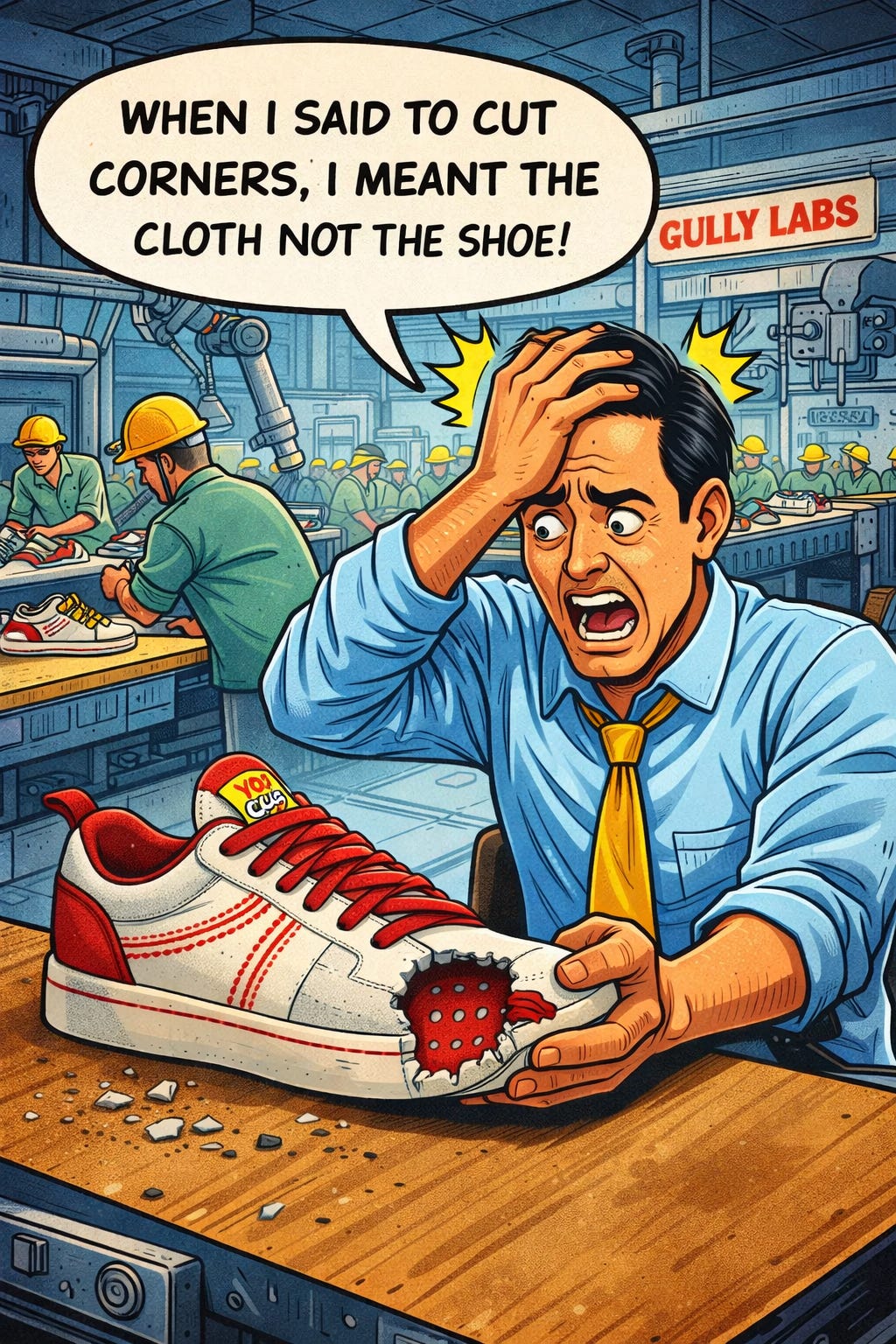
So one is quality. The other is timing - people will say you will get it by this day or this time, but you have to really put effort to ensure that happens. It won’t happen by itself. And the third thing is planning - if you grow by 2x, 3x in three to four months, you really have to plan your life accordingly. To be successful at this business of making shoes, you will live and die by your operations, your partners etc.
It’s the advice I would give out most to people just starting out on their journeys. Problems of scale creep up without you knowing it. Suddenly a good thing will become a bad thing, and that bad thing will compound fast. You should always underestimate how prepared you are, and be a bit paranoid about how quickly things can go off, or how unplanned you can be in a very short amount of time. Be very mindful of scale and complexity, especially in businesses like this.
To sum up - a lot of the challenge for us comes in sourcing materials and getting to spec and getting it on time and having the right partners that are willing to understand what you’re building. It is easy to find ‘average’ everywhere. But when you’re trying to do something exceptional you need to have your hand on the steering wheel at all times.
VII. THE COLLECTIONS — Storytelling Through Products
One of the reasons I wanted to do this is because it feels like - at your core - you guys are storytellers. You’re trying to package inherently Indian narratives in interesting, original ways that resonate with your audience. I’m curious, what does storytelling mean to you?
It’s your ability to communicate ‘why’ - over and over again. That starts with why you exist as a company, but then goes deeper into each product. Why are we doing this shoe? Why did we partner with this person? Why did we choose these materials? Why do we think this design deserves to be celebrated? For us it sits at the core of everything we do. It’s not just something we exploit to sell a product or exploit a cost arbitrage. Gully Labs exist as a commentary on India in the 21st century, the chapters that got us here, and the dreams that will take us into the future.
When it comes to sneakers in particular, when we were starting out, sneaker culture was very much based on hype culture. And because sneaker culture in India was based only on Western or Japanese or Korean sneakers (there wasn’t any local alternative), our hype culture was derivative culture. The original hype did not start in India. It started somewhere else for someone else’s reason. Maybe some cool niche artist or foreign athlete was wearing it, became a movement, spread around. But everything hyped in India is hyped only because it was hyped somewhere else. It’s derived hype, almost literally like a derivative trading product. You’re not trading the actual value, you’re trading the value of movement of another product. It’s very disingenuous.
For us, we could have easily just taken working silhouettes from the West, and touched them up slightly for India, sold it at cheaper price. But that means we’re measuring ourself based purely on what someone else has done. We exist only next to their version of existence, instead of having our own. It seemed like a waste of time to spend our days and energy duplicating something from somewhere else. We’d rather tell an original story instead.
Can you go deeper into the thinking around some of your favourites?
Sure. So, in general, each collection starts from a concept or a narrative or something that we feel hasn’t been given its proper due. All of the other stuff - the visuals, the shoot, the campaign, the dissemination - everything flows from there.
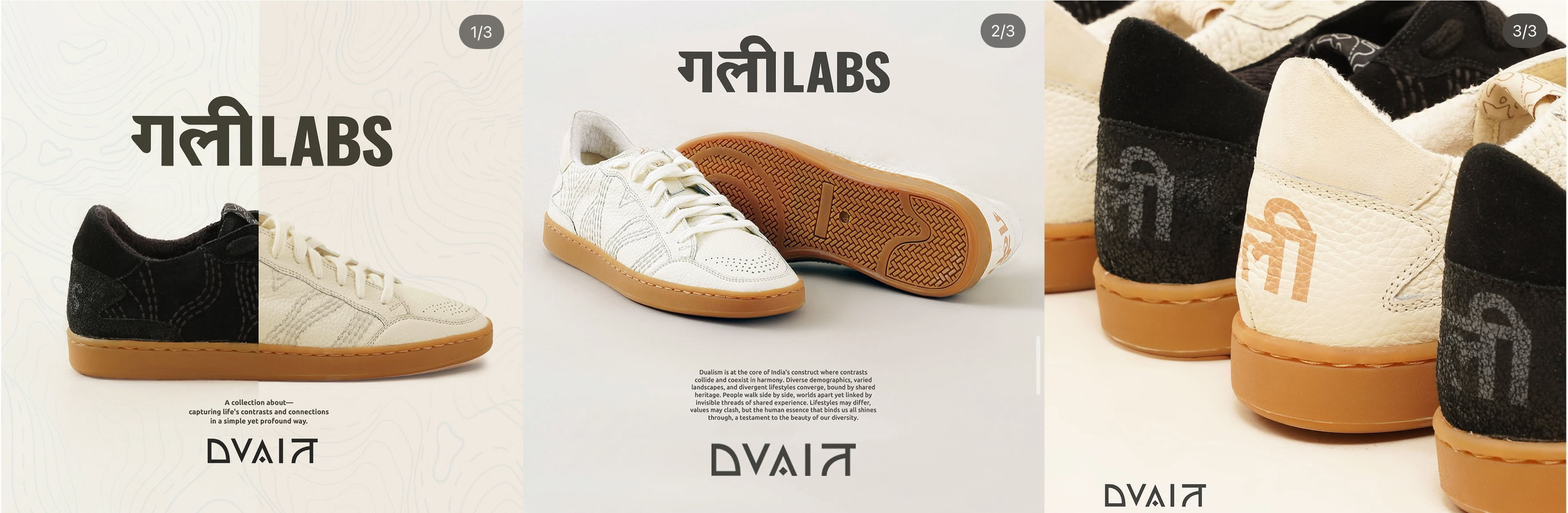
For example, early on we took inspiration from the Sanskrit concept of Dvaita (duality) - of light and darkness - for our second collection.
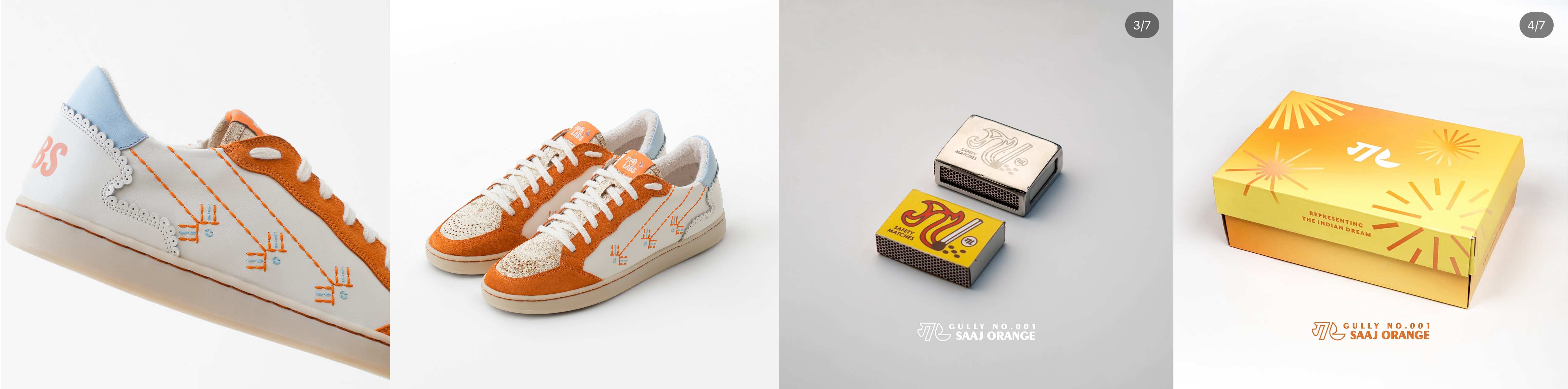
Then we did a limited edition ‘Saaj’ Orange colourway of our 001 collection that released around Diwali. Our thinking was that people all over the world fall over themselves to purchase the Chinese New Year edition of sneakers that Nike or Adidas or whoever else releases, which probably has some cool dragon and firework design on it. We were like why can’t we make a shoe inspired by Diwali in that case? Is the festival of lights not cool enough? We even included a metal laser-inscribed matchbox holder and a candle stand as collectibles in the box. Because for us, even the unboxing is part of the story.
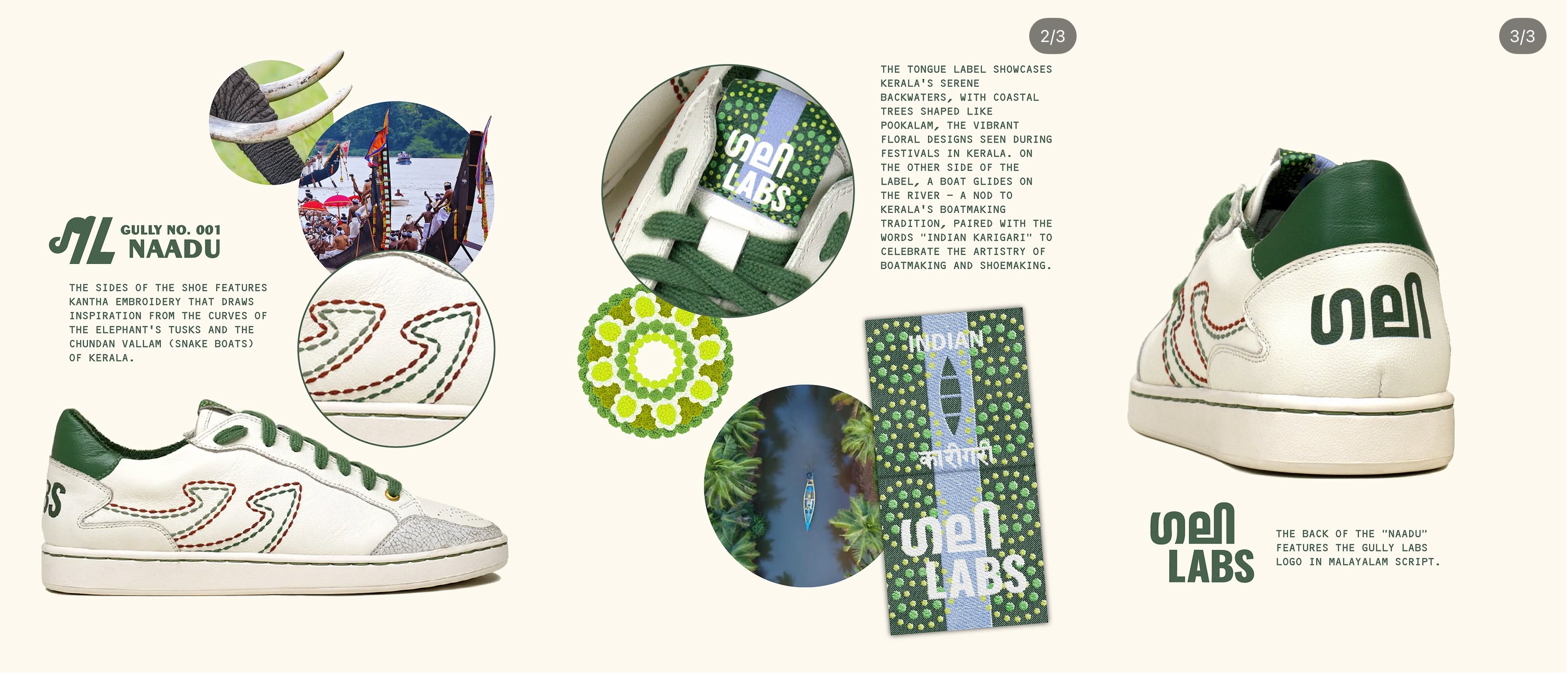
We created another limited edition sneaker ‘Naadu’ for another festival - Onam. This went from idea to product in seven days. Basically Animesh walked into the office on a Monday and said Onam is 15 days away, let’s do a Kerala-inspired sneaker. We had someone from Kerala on the team, so he came up with Onam-inspired imagery - the boat races, the Pookalam flower carpet, the Malayalam script - and baked it into the tongue, the label and the sides. We sent the shoe to the Gully Labs community members in Kerala to shoot content, and that was it.
Another one worth mentioning is the Kulfi collection. It originally came from customer feedback. People told us that they wanted sneakers in more muted colours that they could wear for everyday use. They enjoyed the flashier, design forward silhouettes as well, but couldn’t wear them in every setting through the day. Simultaneously, we wanted to do some kind of summer launch. In the West, LA summers and Miami summers have a specific connotation. But when we thought about summers in India growing up, the thing that came to mind was kulfi! The colours for this collection flowed from there i.e. Rabri, Badam, Pista, Kesar - flavours of kulfi. When you hear these words, the exact shade of our shoes pops into your head.
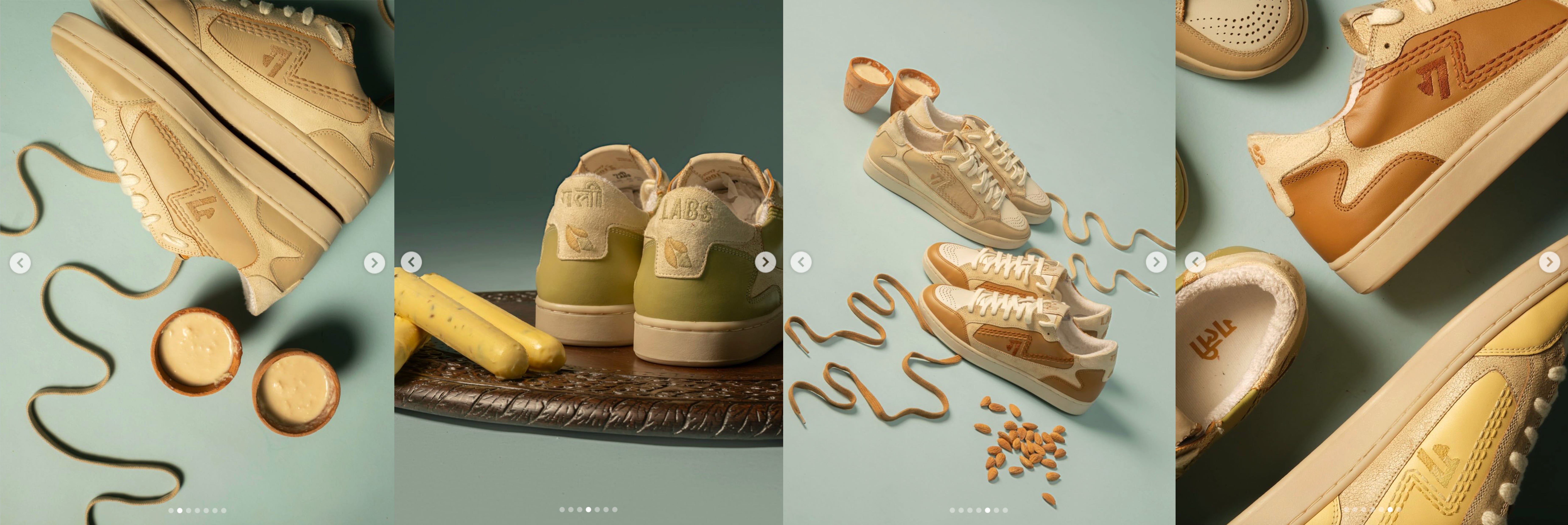
And then for the collectible in the box with it, we added a kulfi mould. That’s how we were able to deliver an ‘everyday’ wearable collection to our community - by taking inspiration from the joy of eating kulfi as kids.
So you guys basically have this novel canvas to paint on. I would imagine that Gully Labs has also become a magnet for collabs and partnerships from individuals and brands that want to ‘rent’ this canvas too right?
For sure. I think we’ve been quite spoiled in this regard. A lot of interesting people look at us as ambassadors of modern Indian culture.
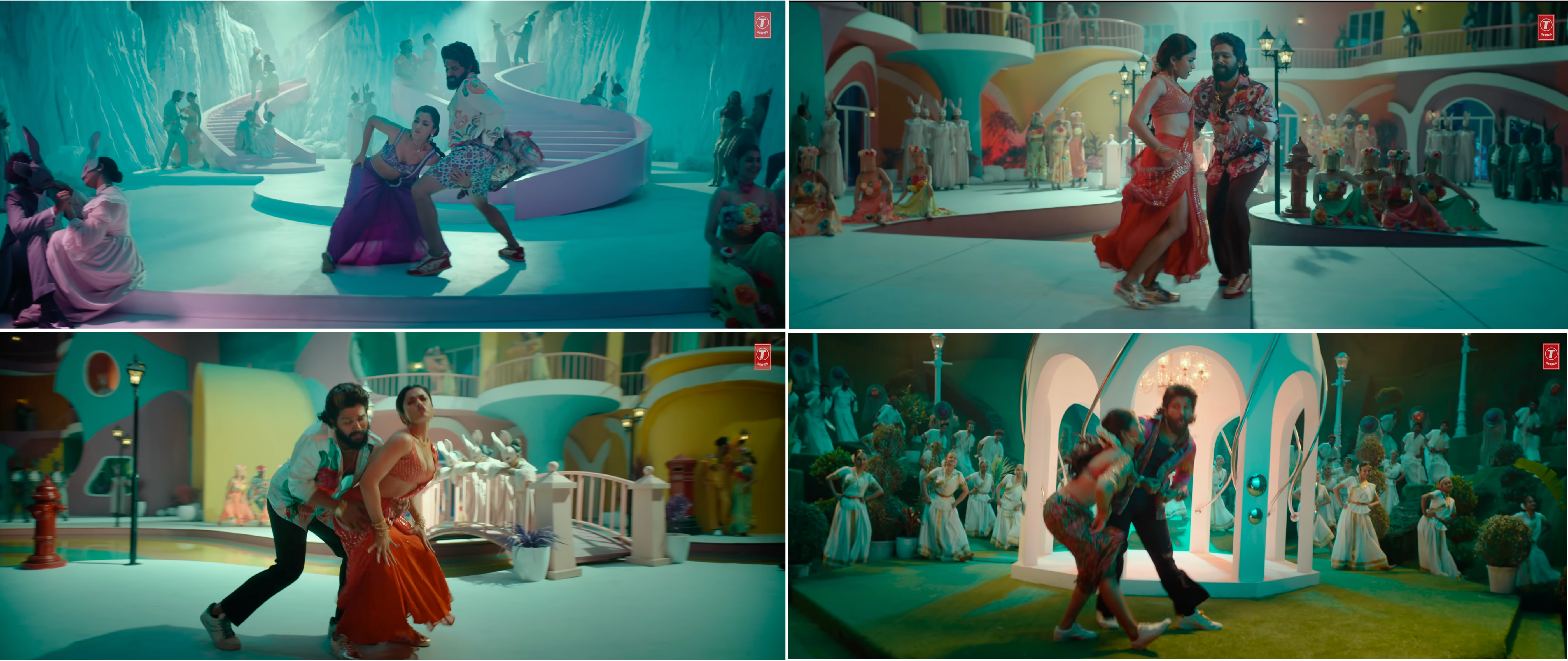
That kind of cultural fluency doesn’t come naturally to a lot of brands, so they partner with us to help them on that journey.
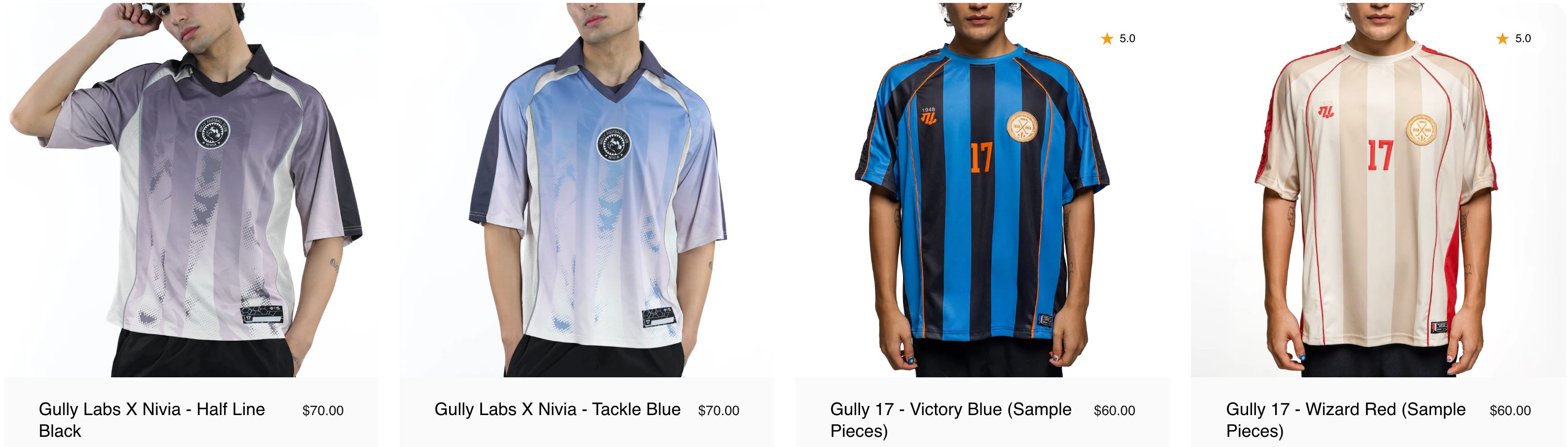
We’ve done a bunch of cool collabs but a recent one I’m proud of was with CMF by Nothing, a phone company with a design sense we’re fans of. Before that was a shoe with Nivia, a legacy sports company with a hundred year journey who have the distinction of being the supplier of the original footballs for the first FIFA World Cup. The Royal Enfield one of course was a big milestone for us.
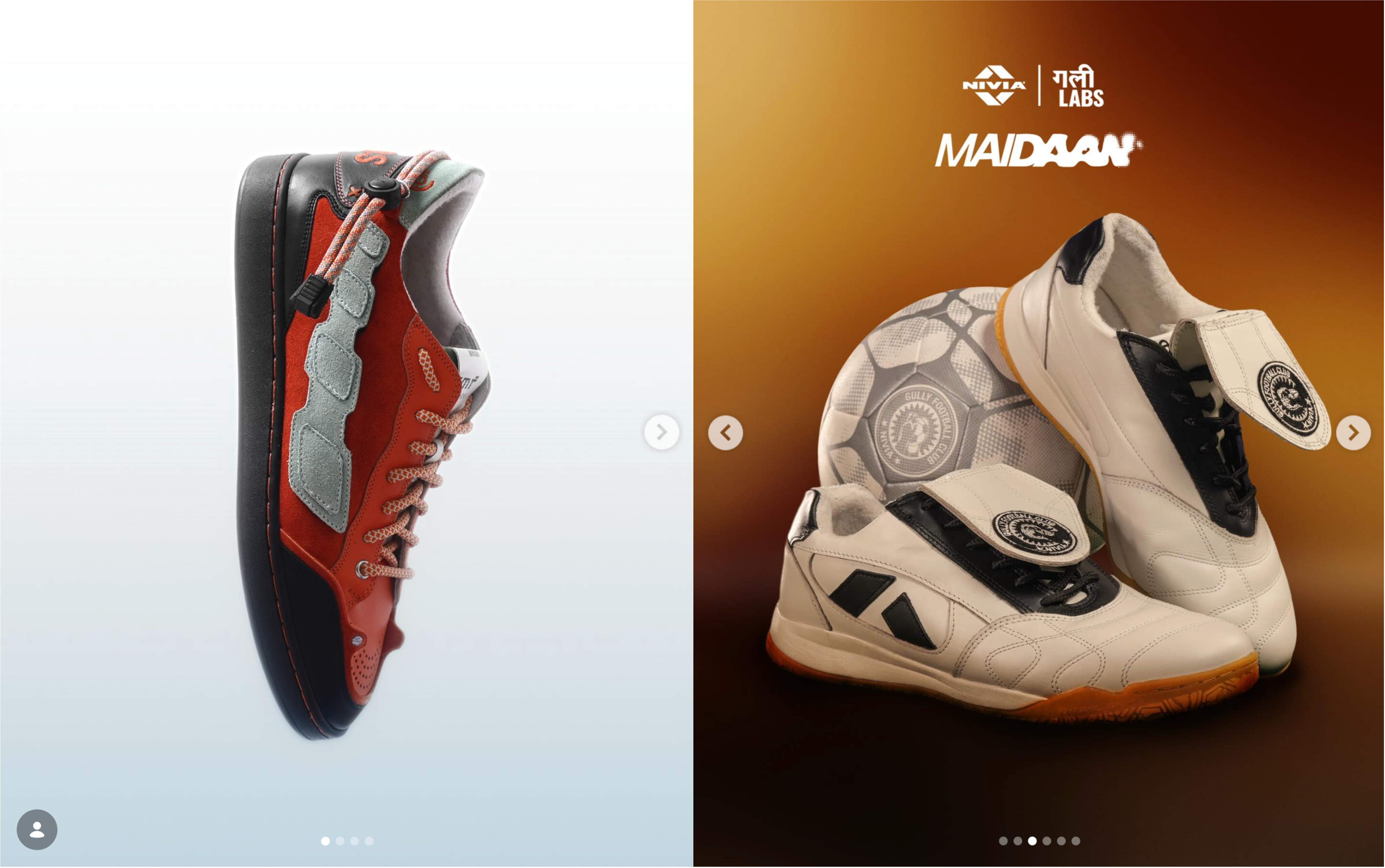
Often times these collabs are a way for us to work with talented people we’ve admired, who can express their creativity in a different medium.
The Baaz Indrani edition was inspired by Indian dance forms and co-created with PRXKHXR. We’d been talking with Prakhar for more than a year. We had actually met someone who knew him in a cafe when Gully Labs hadn’t existed. That conversation kept going. And that relationship became this sneaker, which has become really admired and coveted
‘The Traveller’ was a collab with Yatin Srivastava. Yatin knew Animesh for many, many years. He’s been in conversations with us ever since Gully Labs had launched. And when that collection came out, it was already one year in the working.
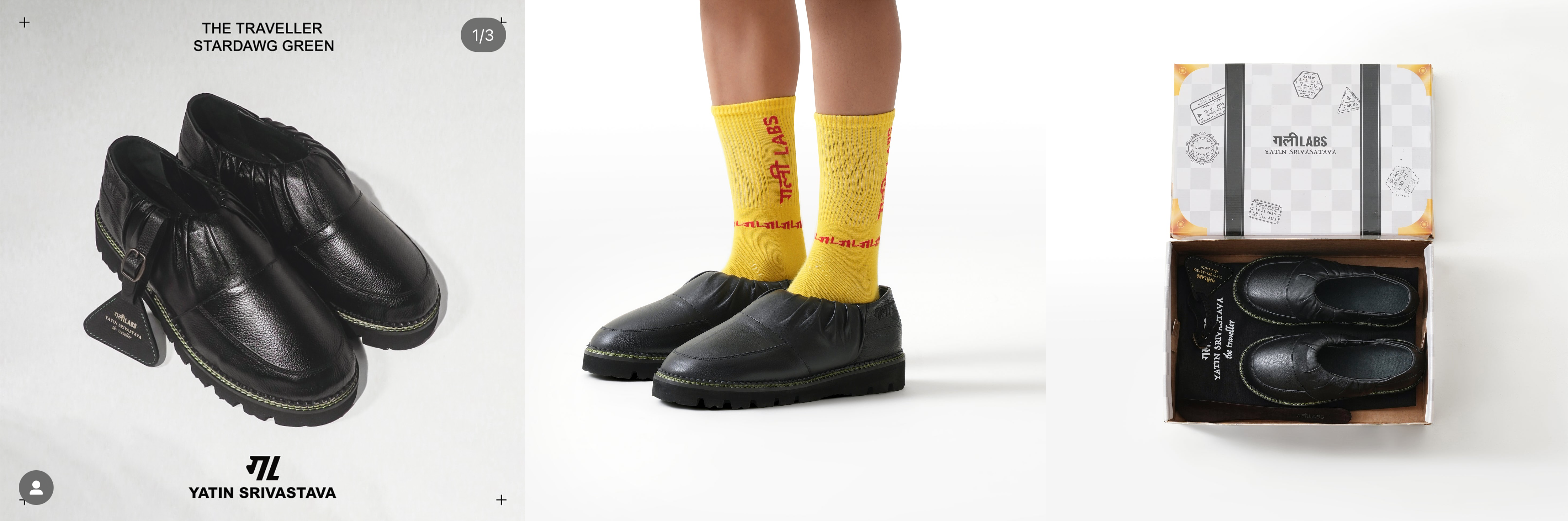
Being able to play long term games with long term people is something we don’t take for granted. We have several more in the works, with a hip hop group we admire, other with some international artists who are making India proud overseas. Another one with a large beverage chain that everyone will know.
Most of these are true collaborations. They haven’t been like - oh, you are popular in pop culture, we are big, why don’t we slap our logo on your sneaker and call it a collab? Our most successful collabs have actually been two entities coming together in a labour of love.
What do these collabs actually look like in practice, for anyone reading this that may want to reach out?
In general, sneaker collabs make sense because a sneaker is an identity artefact. It allows you to represent who you are. It is a way to signal to yourself and to other people. It is a means to self-actualise.
Our perspective is that a successful collab should be one plus one equals three. It should not equal two because that means we didn’t put in all our efforts and ideas into maximising the potential. Why would you not make the extra effort?
If we’re in conversation with a designer or brand and they’re like ‘hey, you guys just do it’ - they’re not the right partner. What those kinds of partners are looking for is more on the lines of merchandising. The likes of Souled Store take the likeness of a TV show or cartoon and sell it. That is not collaboration, that is merchandising.
From our perspective, it’s how can you be as invested in it as we are to make this a success? How are you thinking out of the box alongside us and how are we positioning it to the audiences in the most creative way? For example, with Nothing, it was actually a three-way collab. We had a design competition. Got about 5,000 entries. Both Gully Labs and Nothing reviewed those entries. There was one winning design and then we prototyped it.


Nothing spent time on the product, made the samples. We made a bunch of documentaries with them. So it was very much together. We ultimately dropped 200 numbered pairs on our website and sold all of them in like three days. If you read the reviews, they’re saying they’ll keep them and store them and this is a collectible item. Without trying to, it happened organically.
How did the Royal Enfield collab happen? That was obviously an iconic collaboration and endorsement for Gully Labs so early in its journey.
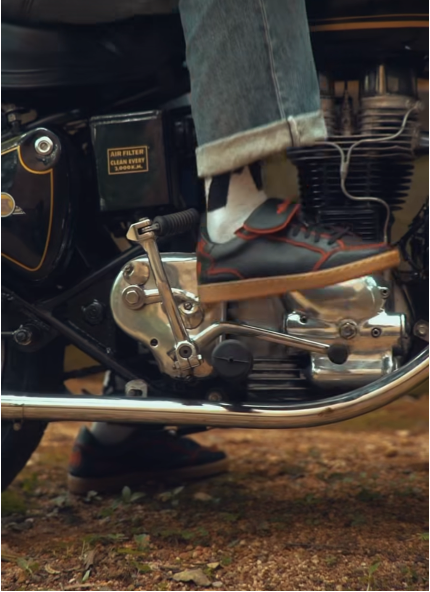
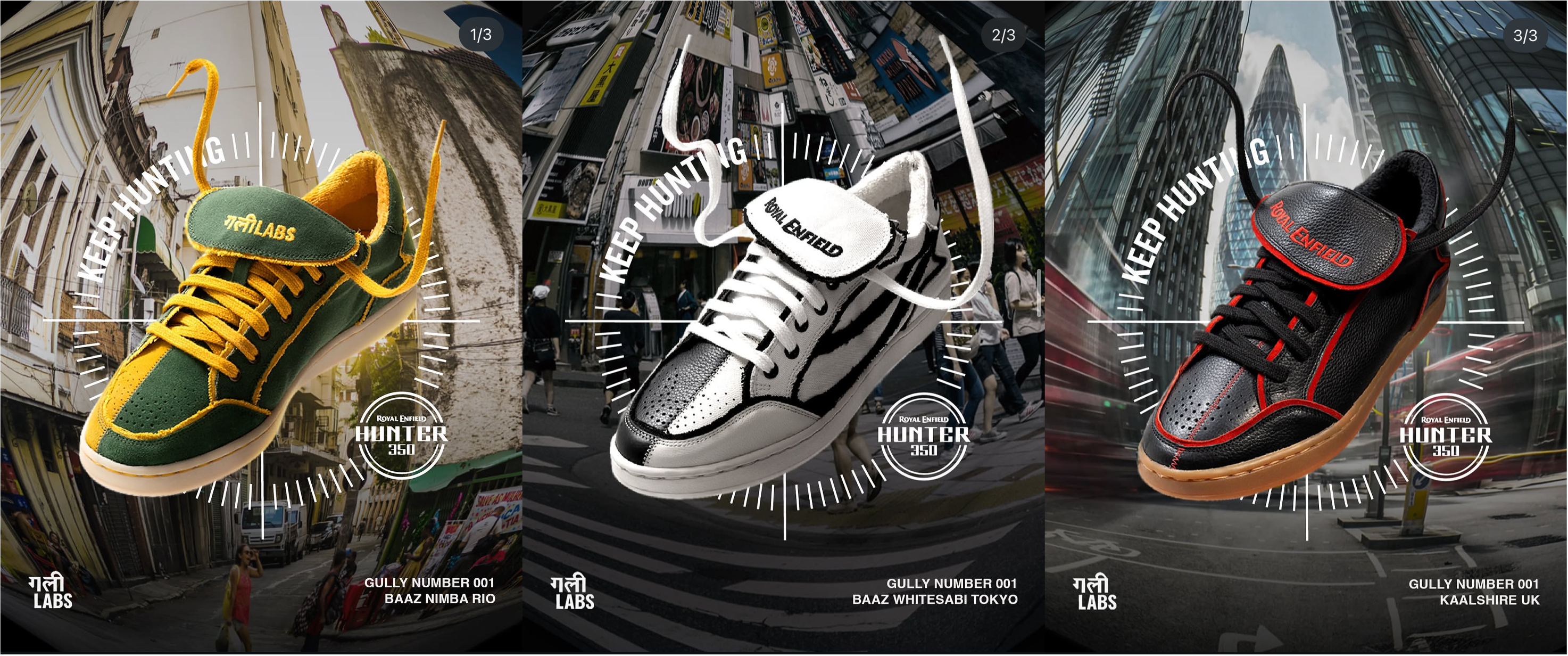
They reached out to us. They were interested in what we were doing - the way we talk about our product and our people, there was an alignment of values. They were launching the Hunter 350 motorbike and wanted to do something together around that launch to appeal to the younger desi biker community.
We worked in a record 45 days - concept to product - with their team in Gurgaon and in the UK.
Quite an experience to work with a hundred-year-old listed company. Honestly, the longest part of the process was probably the legal agreement.
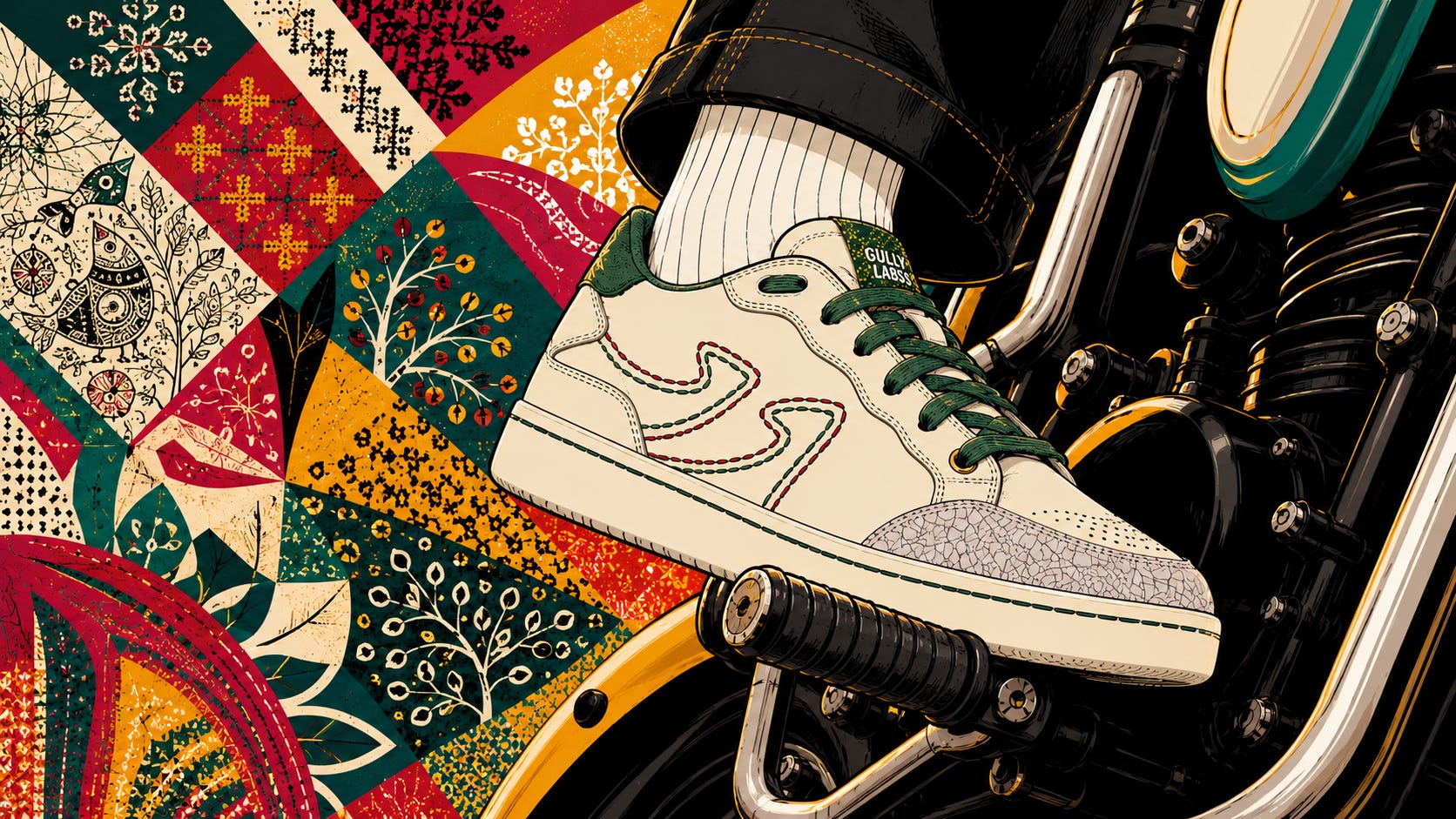
For the shoe, we translated the bike’s fuel tank curves and the CMF (colour, material, finish) into sneaker design language while maintaining our visual identity. The Baaz series silhouette was chosen as the foundation because its versatile components made it ideal for design experimentation. The Baaz motif was reimagined to embody the roadster spirit.
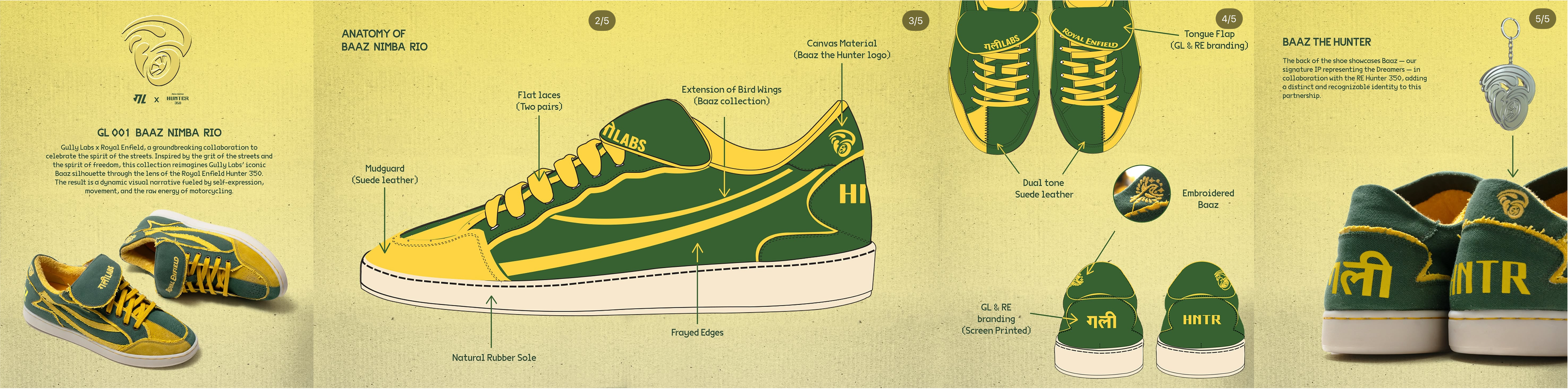
It wasn’t just some logo-slapping exercise. Both brands had to show up in the product in an authentic way. It’s the first (and I’m confident only) moto-sneaker collab in Indian history.
That collab showed us that if you control the supply chain and the product, you can move fast. And that speed makes other brands want to work with you, because most big companies just can’t create a custom product in 45 days.
VIII. THE BUSINESS — Pricing and Scale
On the business front, one of the frequent complaints you guys receive online and on Reddit etc is around the price of your sneakers. And you always provide thoughtful pushbacks on this saying Gully Labs wants to position itself as an aspirational product. Can you talk about the pricing logic? And what does that word ‘aspirational’ mean to you?
A lot of comments online are predominantly one line saying, ‘how come you as a brand from India charge this price?’. I find that to be midwit phrasing. Like, you are implying that the origin of the shoes should in some way dictate that price.
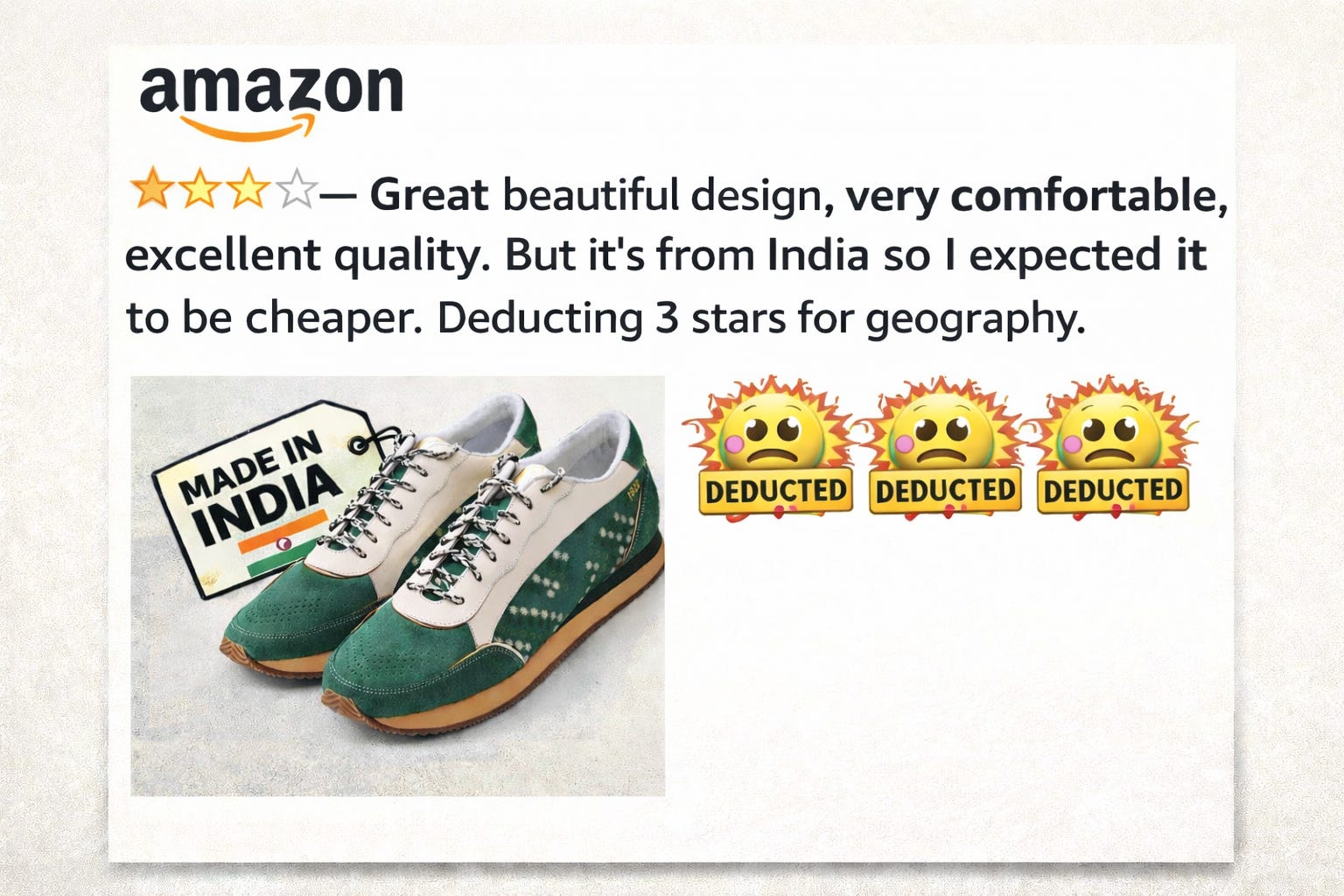
You’re also arguing that something from India can’t demand a higher price tag for its quality. I find that to be disappointing. And the people who write those comments, very few of them will be our customers. For people who buy and wear our shoes, it obviously makes sense to them.
I think the lazy way that people think about it is that if you price it at X high price, it becomes aspirational. But aspirational just means it’s something to be desired. A Rolex is aspirational because of the history and craftsmanship, and the fact that it becomes an heirloom to be passed down. A Mahindra Thar is seen as aspirational particularly in North India because it presents a rugged, adventurous image. We hope that Gully Labs is similarly seen as desirable, because of what it signals about the wearer - a certain taste, an opinion, a confidence, a recognition of quality. It becomes aspirational when it elevates your sense of identity, and it draws a positive reaction from those around you. That isn’t really tied to price.
In fact, some people may be surprised by this but our pricing was pretty much bottoms up. Maybe we are inefficient. But to get that sneaker, someone had to make that sneaker. It was us making that sneaker and that sneaker cost X amount to produce and put it out in the market. And then we had to put in other margins for us to make that business operation sustainable. We had to make sure we were doing right by our karigars. So it was pretty much bottoms up.
Any of the shoes that are made in this hand-lasted process in Italy or something do not cost less than 300, 400, 500 dollars. So from that time investment perspective, they are severely underpriced. We never want to compromise on product quality, so it’s tough to go below a certain price. It would be disingenuous if we created sneakers that fell below our standards, or if we created something that we ourselves wouldn’t aspire to wear.
But don’t get me wrong, we also realise and feel bad that we are alienating certain people with our price point. People want to interface with the brand and come along for the journey. So we’re always brainstorming solutions to this. For example, we wanted to give people an easier entry point into the brand, which is why we launched the Baaz collection at a lower price point of ~₹5000. We don’t make as much money on it as we do on other sneakers. But at least it allows people to enter the Gully Labs universe and experience what we’re about.
If you could give us an idea, where does the price of a sneaker actually go?
Well, most sneaker companies in the world, they sort of operate in the 60-70% gross margin range. We’re similar. Most of our capital goes back into working capital and supply chains (logically if every subsequent month you are making more shoes than you did the previous month, you have a capital hungry business).
We’re probably one of the only shoe companies in the world that uses genuine leather at the price point where we’re selling. Many other shoe companies, other Indian brands, a lot of them selling at 5-10% lower or at our same price, will end up using fake leather, which is PU leather (artificial, synthetic polymers). Or they will have their soles made not of rubber but of TPR (Thermo Plastic Rubber).

And then the actual construction - a lot of materials that we use inside the shoe are also extra, which means six months, 12 months later, when you’re wearing the shoe, it retains its shape, it’s not creasing everywhere, it is not falling apart, it is still a very usable shoe. Our sneakers are meant to last at least 2 years of everyday use. The leather helps expand up and down as per fit and size, takes the form of your feet. Our insole is made of PU, which is more expensive than a typical EVA insole - it’s more durable, more shock absorbing, and moisture absorbing.
And then lastly is our design and the uniqueness - we’re not lifting something directly. So when you combine all of these things, you’re kind of getting what you pay for. And if the sneaker does not work for you, we take it back or replace it. We stand by what we make.
Right, can you give us a sense of the scale today? And how this has progressed since you guys started out?
We started our journey in late 2023 with one model and five colours. We were making 30 to 50 shoes a month essentially out of a garage setup. Monthly sales hovered at 10-20 pairs for the first couple of months till we blew up on Instagram and Twitter.
By end of 2024, we were doing about 600 pairs a month - about 50 lakhs in monthly sales. We raised our seed round at the end of that year - 8.7 cr led by Zeropearl VC, along with Untitled Ventures and some incredible angels like Sangeet Agrawal from Mokobara, Viraj Bahl from Veeba, Roman Saini and Gaurav Munjal from Unacademy, Radhika Gupta from Edelweiss, Sanjay Kapoor from Genesis Luxury.

By end of 2025 this had reached 5,000 pairs a month, 2 crores in monthly sales. Now we have 35 to 40 different SKUs across casual sneakers, open footwear, and we’re also venturing into apparel and accessories like socks, shoes, perfumes etc. We did roughly 30 crores annualised revenue last year, and we’re targeting 100 crores annualised by FY27. Then in January this year, we closed our Series A - 30 crores led by Saama Capital. Zeropearl doubled down beyond their pro-rata too. We wouldn’t even have announced it if the press hadn’t caught wind of it. And late last year of course we also had a fun (and rewarding) journey into the Shark Tank.
On the team side - we went from 2 people to about 120. The factory went from 1,500 square feet with 6 karigars to 10,000 square feet with 50-plus. And we opened our first flagship store in Panchsheel Park, South Delhi. So far we’ve been about 90-95% D2C, which is intentional.
IX. THE VILLAGE — Content, Community, Customer
Tell me about your flagship store launch. I had the chance to visit in February where we met for the first time. You can tell how much thought and care has gone into bringing it to life.
We didn’t want our first effort at designing a physical space to be weak or vague. We wanted to be super opinionated, just like the brand is.
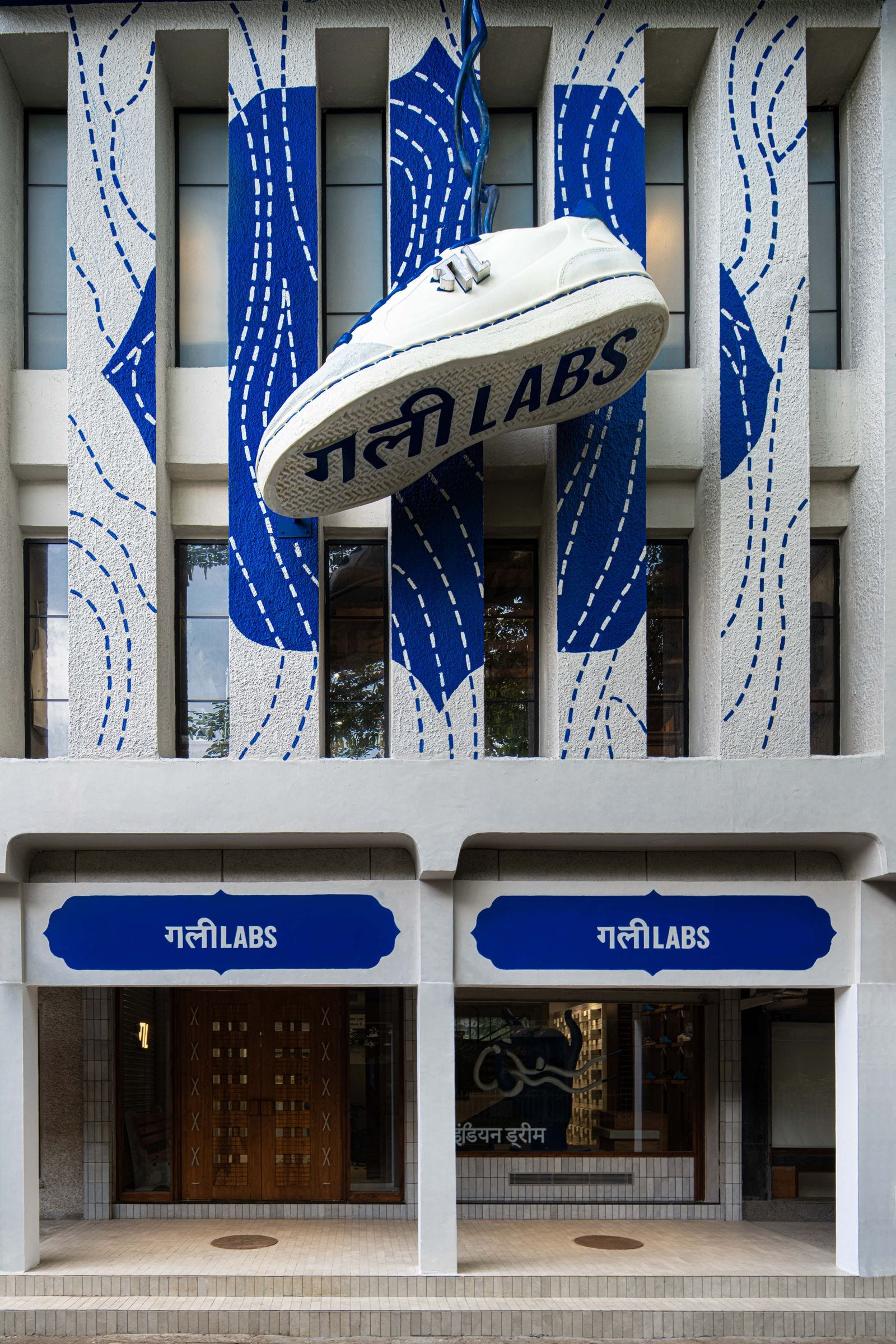
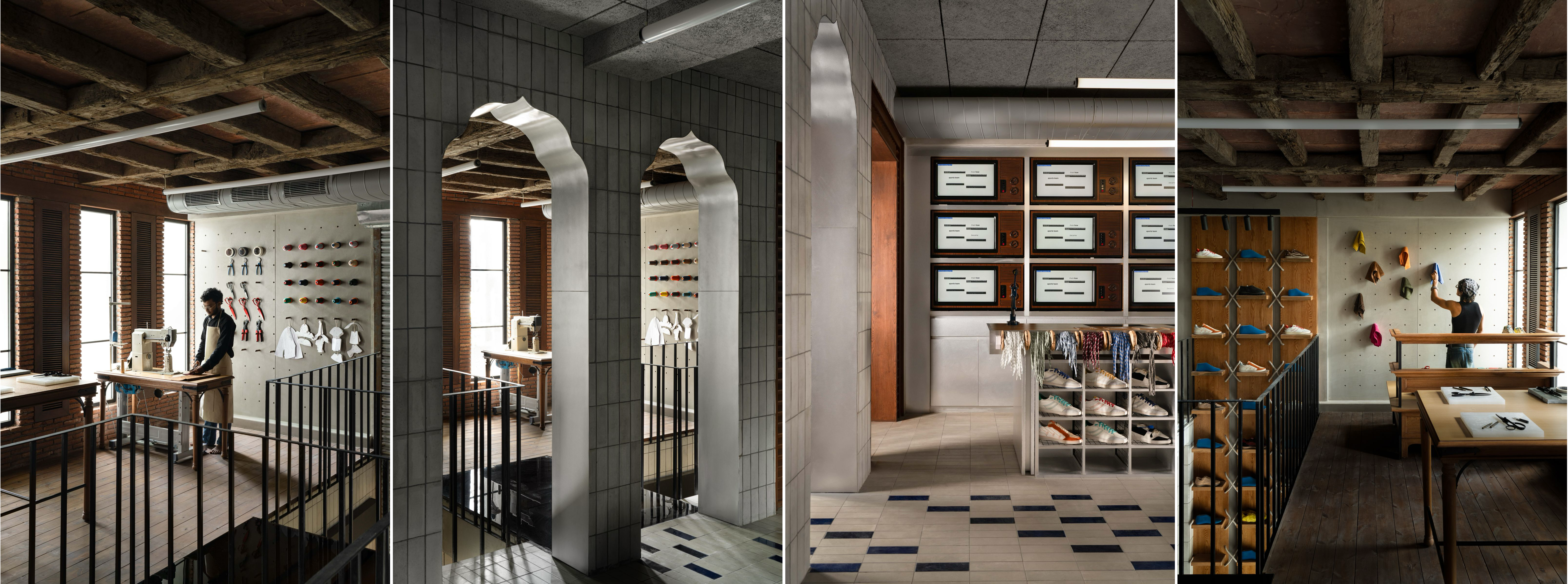
We worked with Dhruv and Pranvi from Milan Studio - extremely creative, original thinkers. Every corner is thoughtful. There’s Subko inside for coffee, which is like a full circle moment for us, being longtime fans of what they do. There’s a customisation station on the first floor where you can get anything embroidered on your shoe, chains, charms, custom text in Hindi or English etc. There’s a meeting space we call the Baithak. It’s a community space where we host meetups, parties, events, movie screenings, workshops etc. It was inspired by the fact that in every village, in small cities, there’s a tree in the middle and everyone sits and chills under it. That’s the baithak.
And it was important to us to have our karigars in the store. Instead of asking us how shoes are made, customers can go directly to them. See how they make them. See the craft. It is a work of art, honestly. People talk about Italian craftsmanship but we have third generation shoemakers in India who’s skills match up in every was. India has been the second largest exporter of shoes. But there’s this ambient noise that only Italians have great craftsmanship. Of course they do. But we do as well. So why not share those stories?
Culture doesn’t exist in isolation. It needs to be where people are. You can’t just be sitting online writing about culture and typing on your keyboards. You’ve got to meet people where they are.
How does offline and physical retail fit into the overall story you’re telling?
It’s always been a big part. We actually started much sooner than a lot of other brands. For us, being physical meant being tangible. The store is a manifestation of our identity. We don’t want to be an online only brand because then you’re just an online only player. All the people that we end up co-signing, rallying behind, the collaborators, artists, any place where culture exists - we wanted to have a place where all of that can coalesce and come through.

From a customer POV, because sneakers are something you touch and wear and feel - it was just paramount for us to be able to provide that facility. A lot of brands get away with nice photos online but products that don’t live upto those images. So that mistrust of Instagram shops is something embedded in our psyche, and having a space to welcome people helps to alleviate some of those issues.
You also unlock the hesitations and shape the perceptions of so many more people who are able to experience your brand fully. The funny thing is that those previous questions and suspicions about price tend to disappear in an offline setting - for people who come to our store (vs just look at our stuff online), they get the justification they’re looking for. The environment helps us sell customers on what the brand is about. So in a very short period of time today that store has become about 15 percent of total sales since it opened.
On shaping perception - right from the start you guys have been extremely savvy with your content production and marketing. You’re one of the few brands that’s nailed the holy trinity of content, community and commerce. To you, how do those three symbiotically support each other?
I think all those three things are pillars of a successful modern consumer brand, right?
For a lot of other brands, content is distribution. But for us, content is product. It has to be independently good enough and of a high enough quality to stand on its own two feet. And it also needs to be better than anything else that’s out there.
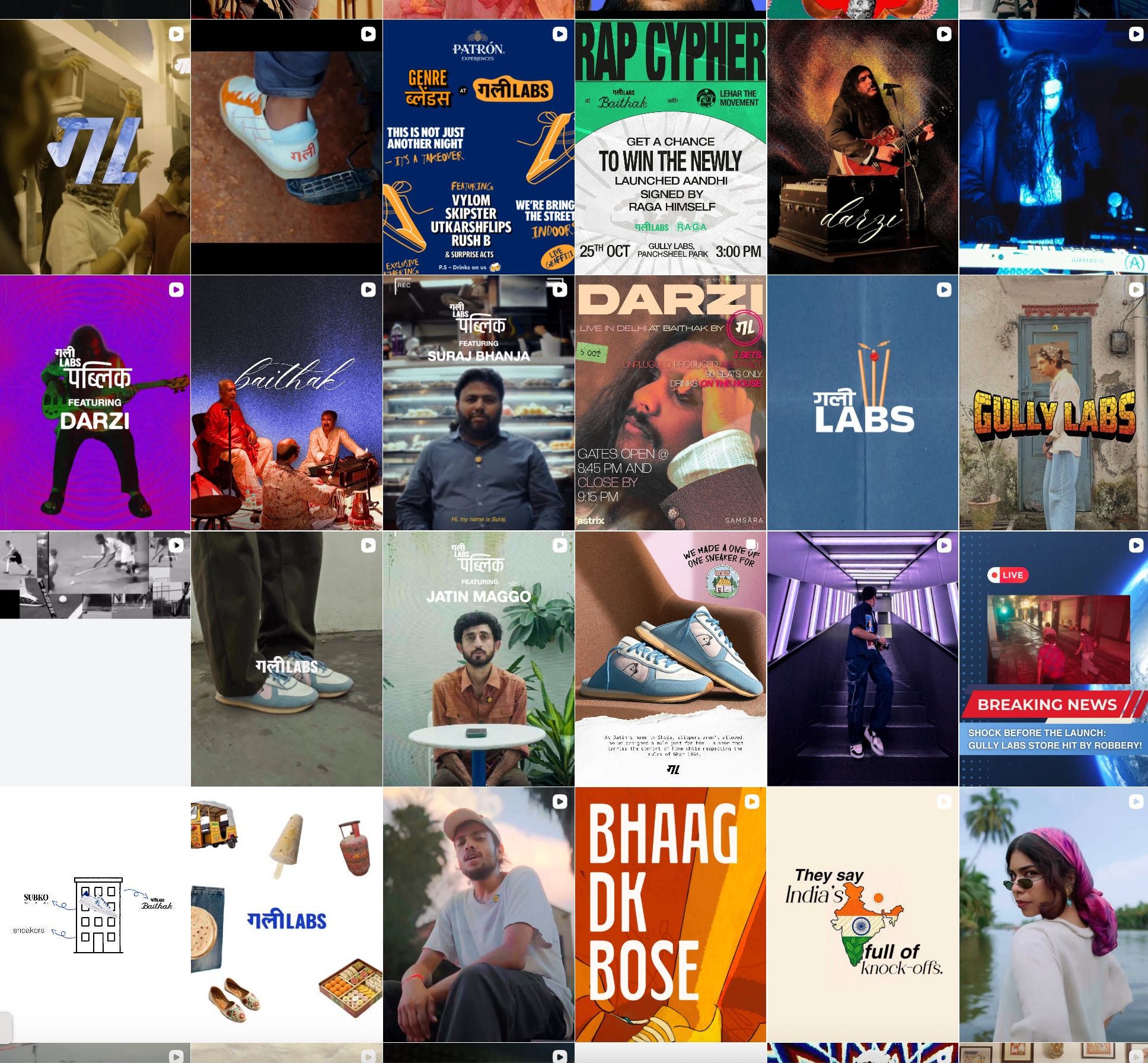
It’s why we do most of our content in-house. Because every collection has its own story, the brand has its own story, and it has to be narrated consistently. It can only happen when the brand itself is doing it. For context, our marketing spend including all content creation is less than 20 percent.
What content allows us to do is give us an arbitrage over reaching the right people the most quickly, because that is how the Internet is structured now. It gets our story in front of the right people. A good piece of content can make things happen for you in some far off corner of the world.
But we also realise now that we need to be where people are. Everything that we stand for and build for is rooted in a human experience. Regardless of what anyone says the world is spending more and more time online. But if you give people a good reason to get out of their house, and design good in-person experiences, they will happily show up and take part. And that creates the strongest brand affinity that you can get.
Would anyone show up to something that a Westside or a Zara does? It’s less likely than people lining up for brands like Blue Tokai. But getting people to show up is how you know you’ve got something special. It means people are willing to make time for you, not just spend money. It means they align with you and what you’re doing. I don’t think there is an exact playbook for this, by the way. I don’t think it’s something you can just copy blindly. You have to figure out what works for you and your brand.
So how I’d sum it up is I think content tells our story to the most people. The algorithm gets us to the right screens. People know about us. A community builds around us, which also brings the distribution. And commerce sustains all of this. If we don’t sell shoes then everything that we do collapses because it is sustaining everything else.
From the outside, maybe someone may think that we do content and community to make sales. For us, it’s the opposite. Selling shoes and growing sales is the main priority, that’s what allows us to do the other stuff.
My advice for anyone building a new brand trying to balance all these things — try not to solve for everyone. Try to solve for one kind of customer who really cares about your product. Because if you can make that specific person happy, they’ll tell everyone around them about why they love you. You can’t get that reaction serving a generic product to a generic audience.
Who are you actually solving for? Like, for someone choosing between a Gully Labs sneaker at 7-9K and a New Balance 550 at the same price — what is the story they’re choosing to buy?
So I would say our core demographic is late Gen Z and early millennials, with about 50% of the customer base in the 25-34 age group. NCR, Mumbai, Bangalore are the top three domestically. And then interestingly tier-two cities — Indore, Coimbatore, Kochi. Internationally, London is actually in our top 10 cities for sales, which is pretty wild.
When it comes to target consumer, there’s a segment of customers that we call ‘the original Indian sneaker head’. Anyone who’s in the sneaker circuit, who’s familiar with hype culture - they know of New Balance, Nike, Jordan, Puma, Adidas, Asics, Onitsuka etc. But there is a whole other segment who have also heard about these brands, but never really got it. Like why is everyone rushing towards these brands? These companies are too far away from this consumer, in terms of relatability.
For those people, when a brand like Gully Labs comes along and offers a product like the 003 Indo-Punjab or the Shahi Collection — it strikes a very different chord with them. It’s much more authentic. It fits in with their identities, lifestyles and context.
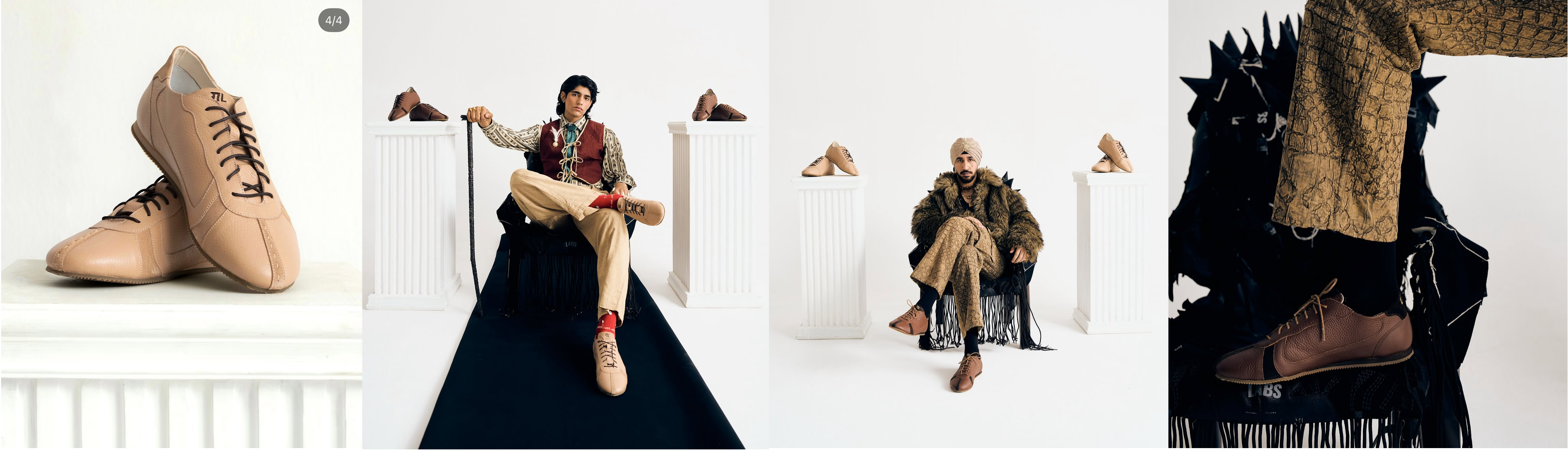
So while we definitely cater to the typical sneakerhead audience as well, who we really want to appeal to is this group - who could be under 20 years old or over 45 - for whom global sneaker brands have never moved the needle. It goes back to the quote we were discussing at the start - “the object is the excuse to buy the story”. For this segment of people, until we arrived, the object was always there, but the the story never made sense. Now it does.
You’ve said that 25% of revenue now comes from outside India. Who is that customer?
It really started with Indian diaspora - first gen, second gen, third gen Indians, people of Indian origin who saw something unique and it spoke to them.
But slowly that ratio is changing and you have more and more non-Indian people buying. The rationale is twofold. One, a good product, a good sneaker is a good sneaker anywhere in the world. If the design speaks to you, you will be attracted to it. And what we’re doing is kind of fresh - with the designs and inspiration we’re tapping into. So American sneaker influencers talk about us, and they get a bit more street cred for showcasing a shiny new toy to their audiences.
Second, the whole craft from India and India’s deep design language - it is logically beautiful, logically elegant. Anyone who’s seen Kantha, Zardozi, Phulkari, all of these styles, they have a lot of history, a lot of beauty and a lot of rationale to exist. Once you start learning that and people want to consume it - if it’s a good product, if that narrative and craft makes sense on a sneaker, why wouldn’t you want to be a part of it?
Korean soaps are consumed eagerly in the US. Indian food is consumed. So why not Gully Labs?
X. THE CULTURE — India’s Moment
From your vantage point, is India having a cultural moment right now?
For sure.
I think this actually starts within India before it reaches outside our borders. You see it anecdotally and quantifiably as well. The things we consume, we are making more of it ourselves - be it apparel, food, pop culture, everything.
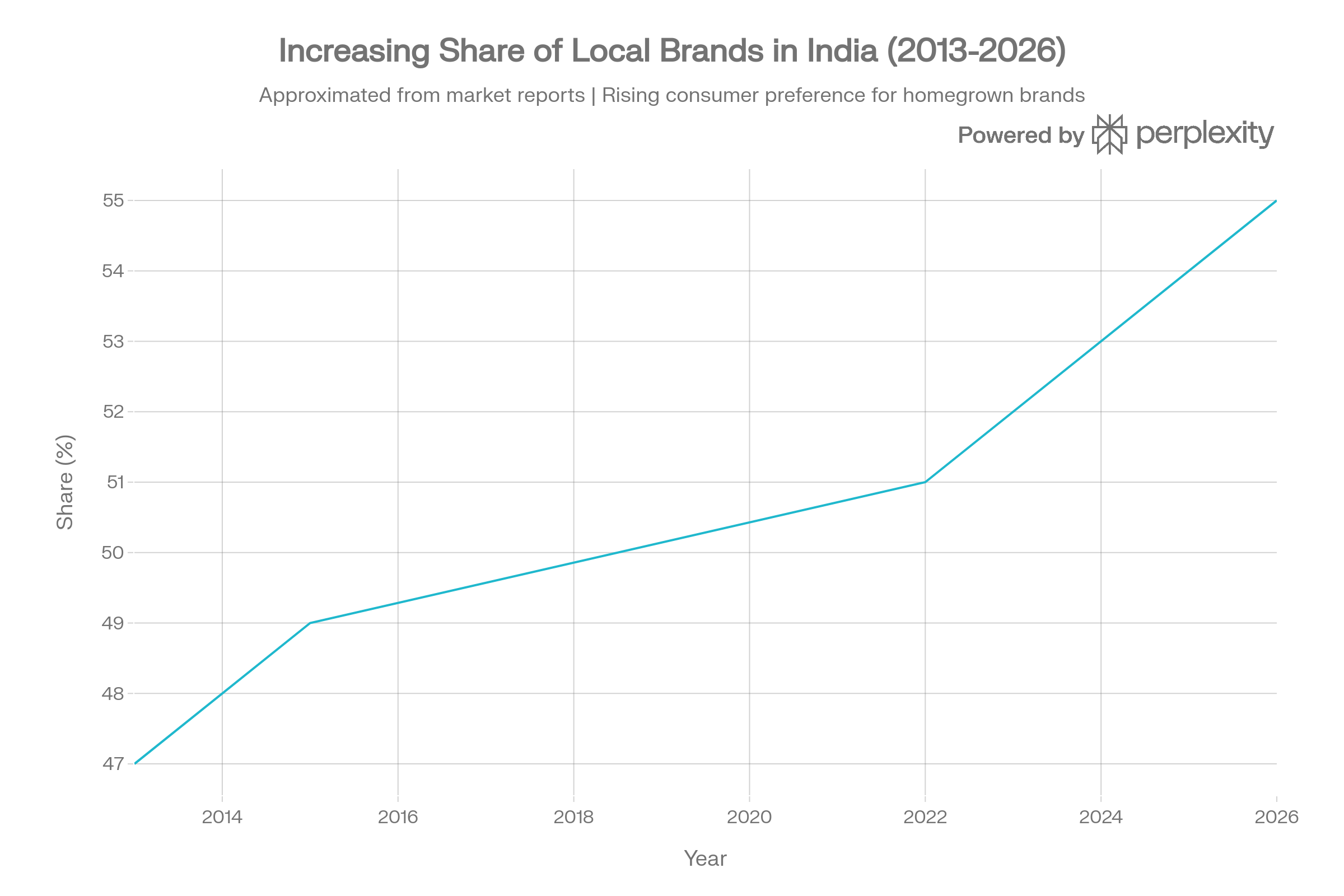
If you look at the share of your wallet spend and compare it to 20 years ago, you can see how we are consuming more Indian brands, how we’re ascribing value to homegrown things in a way that we didn’t use to do before. And the interesting part is this isn’t just for everyday essentials, it’s for products that you’d previously have described as ‘aspirational’ too.
Our own self-assurance is being reflected in the global zeitgeist. Right now, our cultural relevance and our global voice is getting louder. And while there’s definitely an appetite for this, occasionally that will attract a negative reaction and bouts of hate. That’s the risk you take when you get on stage.
In general, our ability and potential to contribute to the global cultural discourse is limitless. Because as a population, we speak English really well. We are philosophically aligned with the broader global conversation. There is immense potential in all our softer parts - art, culture, media, fashion - to find a home amongst global audiences. Our brands and our products are for sure a manifestation of this.


People have a right to demand more of Indian-made things now. For a long time we were just playing copy-cat, making do with shitty products and standards. But now we have an obligation to represent ourselves to the world the right way - leading with quality, creativity, and originality.
You could argue that this is right on cue. India spent many decades mostly worrying about survival. It was literally a case of do or die. Now we are more confident. We are mobile - everyone has a smartphone and access to the Internet. Inspiration and communication have been democratised. We have a billion-plus people who aren’t shy about expressing themselves. It’s time the world heard what we have to say. That’s the optimistic view anyway. As an entrepreneur, you always build for the optimistic view, otherwise there’s nothing to look forward to.
You’ve written about the difference between ‘truth’ and ‘beauty’ before, and how India had to choose survival over self actualisation for a long time, how does that apply here?
This going to be super nerdy, and maybe overly philosophical, but it’s something I’ve spent a lot of time thinking about.
So for the longest part, in our parents’ lives and their parents’ lives, they had to always choose between leisure and pay cheque, or a need and a want, or a painkiller and a vitamin. There was always this trade-off that was ultimately dictated by the prevailing environment of scarcity. Like, even if you were going to take a holiday for seven days, you’d do your best to visit seven cities in seven days so you didn’t ‘waste’ any of it.
As India grows economically, and disposable incomes rise, and people get used to the idea of spending money, our needs shift from need-related things to more abstract desires. We become less logical and let ourselves appreciate the softer sides of life more.
I’ll try and articulate this with an orthogonal example. Take the current moment we’re in. AI is coming to the fore. It will probably do a lot of jobs better than most people. But these will be problems of logic and maths. Humans will exist to provide direction and meaning to computers in an era of machine intelligence. The world will almost get bifurcated into two pursuits. One is of ‘truth’ — absolute knowledge, laws of physics, how to design a circuit board, how to programme a robot etc. Very deterministic. What you feed in is what comes out. The other is of beauty - a supremely human endeavour, governed by something beyond what is programmable. Skills and tasks and output that is more than the sum of its parts. An AI cannot understand me, my journey, my lived experiences, and my desire to express myself and my pride in my Indianness (at least for now).
The company we’re building hopes to bottle that feeling. We want to be directionally in pursuit of that sentiment - what we describe as ‘beauty’ - and infuse everything we make with that same feeling.
Are you seeing this manifest differently across the younger generation?
We’re all a by-product of our environment. And the environment these days for young people is the internet (or whatever part of the internet you consume).
In a weird way, anyone who spends a lot of time online is unchained by the past. You are consuming what is now. So younger Indians today adopt less of that historical baggage - that inferiority complex - that prevents them from recognising the greatness of their own culture.
For instance, if you look at the Bollywood movies of the 60s and 70s and the music from them - the lyrics are actually kind of bleak even if the tracks are entertaining. So many of those songs are some variation of ‘we could not find food or water, life was so tough, but I still found love’. Those movies were a very real reflection of the prevailing national sentiment.
Contrast that with music now. It’s inspired by so many different kinds of lived experiences in India. Artists can be braggadocios, provocative. They can take you on a hero’s journey or an alpha journey or a struggler’s journey. There are many adventures to choose from, for maker and listener. That’s cultural evolution.
To me it’s a sign that we’re becoming more at peace with our identity, at peace with our past, acknowledging it but allowing ourselves to not be constrained by a single, static, historical version of India. Younger generations tend to be bolder, and so they’ll lead the charge here. But it’s a gradual process that the entire country is on too.
How does this feed into making a mark on the global stage? You’ve talked about IKEA creating a template for globally recognised Scandinavian design language. Is that the onus for Gully Labs?
Not just us, for all our peers too. Because of the history of India, our unique context, the diversity of influences we can boast, we have this infinite canvas of design and culture to offer the world. It’s an obligation for us to share our story collectively, in whatever form that takes.
For instance, Kartik Research packages the kinds of designs you would find in any Jaipur textile market, and contemporises them at luxury prices for a Western audience. Indie Wild is doing something similar with traditional Indian health and wellness practices. Both are doing an awesome job.
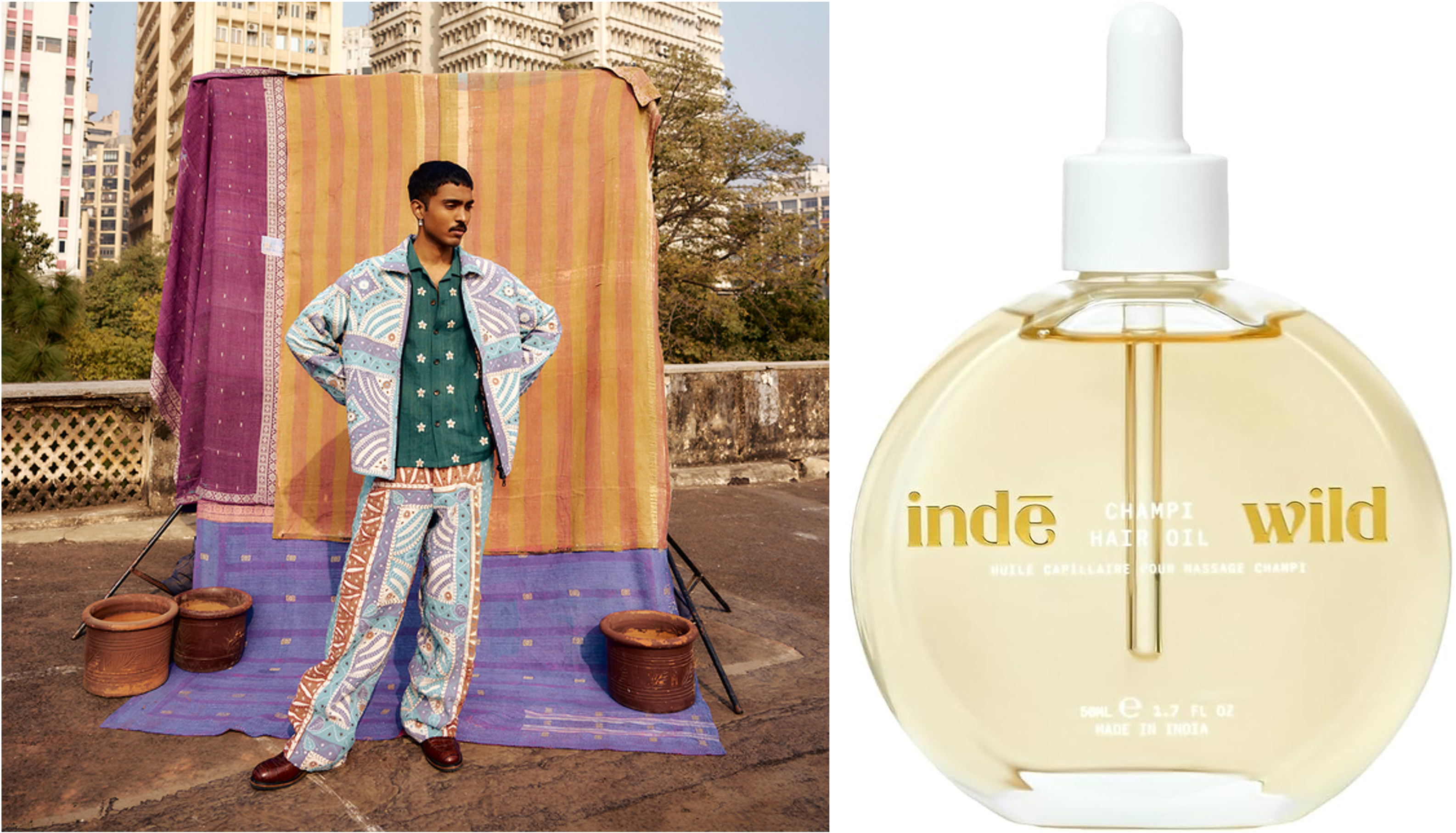
Brands like Subko and Pista Barfi are taking a bold stance with modern Indian fonts and packaging and designs. You look at what Raw Mango is doing with saris or what Torani is doing with Indian fashion more generally - it’s amazing. I buy all my T-shirts from this brand called Stamp Duty that is doing excellent work too.
What binds these brands together is they’re all pulling from an Indian design palette, but doing it in an original and modern way (because there’s so many different sources of inspiration to pull from). They’re not copying Western brands or hiding behind anglicised names. They’re saying ‘this is our narrative, this is our journey’. And they’re leading with quality and originality, not just lazy nationalism. That hasn’t really been done at scale before.
So while the older paradigm might have been companies like Zudio and Westside sourcing products that do well in China and selling them in India. We think we sit in the next paradigm of product design and brand building, that takes inspiration from India and then sells this story overseas. It’s very early but I think over the next few years you’re going to see a tidal wave of products and brands that represent Indian design thinking expressed in contemporary objects, the same way IKEA might have done for Scandinavia, or Muji does for Japan. People will recognise them for their utility, their aesthetics, and their ‘Indianness’.
XI. THE FUTURE — Where Is This Going?
Gully Labs just raised a ₹30 Cr (~$3.6 mn) Series A from Saama Capital and others earlier this year. Where do you see those funds going over the next 12 to 18 months?
If I could reduce it to two main answers - one would be distribution, and two would be product development.
On the first, we want to be where our customers are, both physically and psychologically, which means both bolstering our offline presence, as well as solving for ‘sneaker-adjacent’ use cases. If our community is out there looking for interesting chappals, we should be there to fulfil that desire.


On the second point, so far we’ve been very brand and design focused, but we also want to go super deep into product. That means creating our own soles, our own insoles and going deeper into creating the best functional products as well (performance shoes, casual trainers, accessories etc).
And the last avenue would be hiring. We want to invest in the right talent, and give them the time to let their contributions come through to properly impact what we’re doing.
You guys have taken several large strides in a pretty short period of time. What would you say is the biggest difference between how you operated a year ago vs now?
A year ago, things were very direct. We could be more spontaneous. Now, as we mature as a company and brand, we need to be more thoughtful. It takes a bigger lever to move things at a bigger scale, so a lot more intention goes into each action. Tangibly that means your back end system, your supply chain - those things need to be humming smoothly. More organised, less chaos.
We’ve been almost forced to go from ‘I will act today and see the results tomorrow’ to ‘let’s plan, organise ourselves, and prepare communication before we even take an action’. That’s a big change. Last year we would advertise shoes that we didn’t even have in stock, and make them to order within a week. We can’t afford to do that now.
Is international expansion on the cards?
Hopefully by next year we should have done a pop-up or two. But first we’re planning three new experience stores in Bengaluru and Mumbai to cater to the domestic market first. And then a physical outlet in the US within 12-18 months. That’s being driven by strong inbound interest at the moment.
What does Gully Labs look like in five years? Where is this thing going? What does a best case scenario look like?
I would say that Gully Labs will always be a shoe company first, but one that is fluent across other products - like, I can see us making a splash in areas like fragrances, apparel, and even jewellery over the next few quarters.


I think we will always be an institution that keeps the idea of ‘India’ at its core. There are endless designs and narratives and themes from the Subcontinent that we are yet to explore, and those we want to do alongside our community.
I would hope that we have a strong presence both within and outside India, confident in our roots but nimble enough to take inspiration from what’s around us wherever we go - a little touch of Bangalore when we’re in Bangalore, a touch of New York when we’re in New York, and so on.
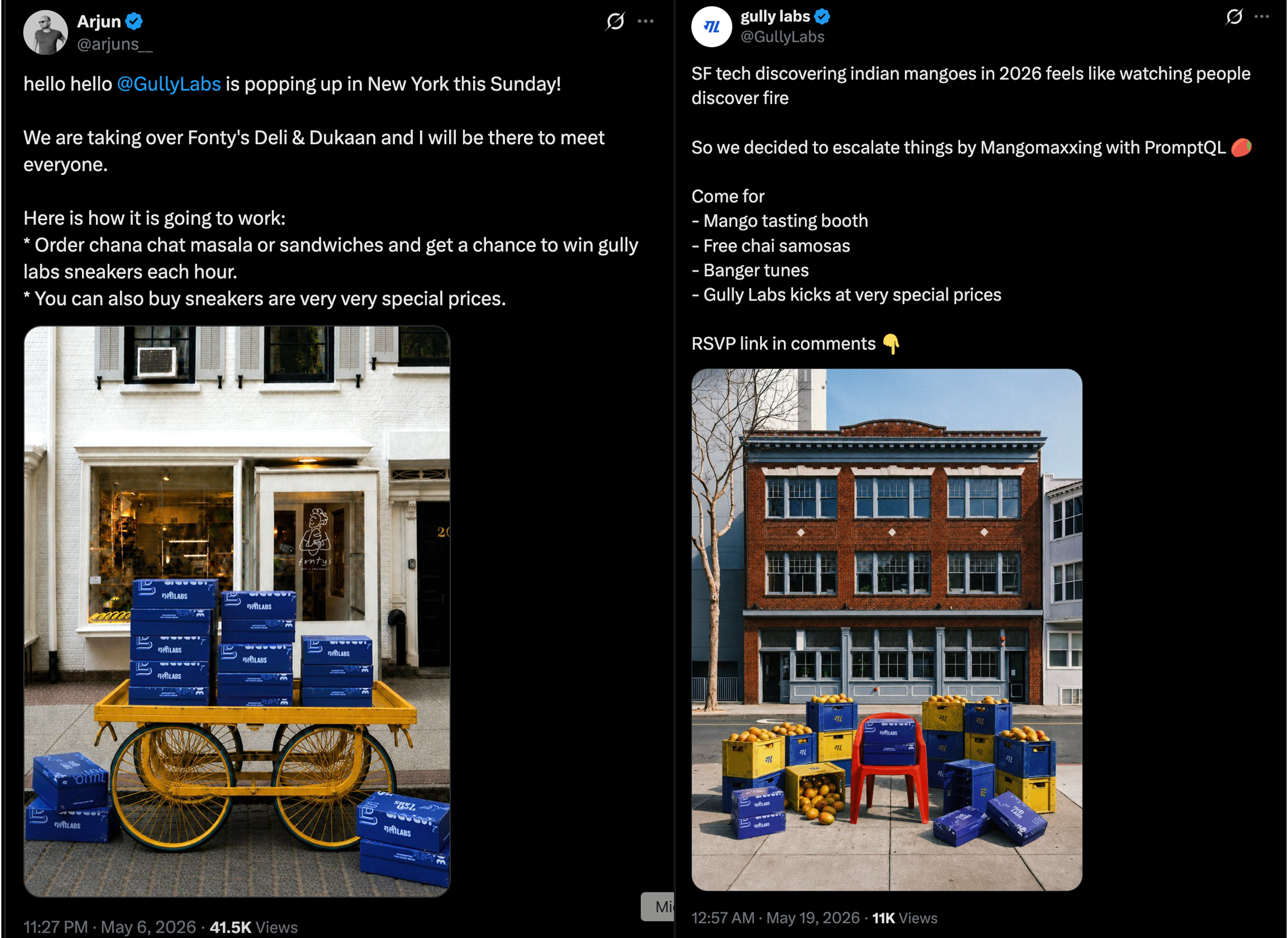
I would hope that we remain part of the cultural conversation, helping to amplify the talents and impact of designers, pop stars, athletes, entertainers and stories that inspire us, using our unique canvas and medium.
Ultimately, like I told you at the start, we are here to represent the Indian dream - which is no longer about leaving India, but about building something here that the world wants to be a part of. That will never change. So every sneaker, every collection, every piece of content is us trying to make that case. One pair at a time.
More references/links
Ep 15 | Gully Labs के Founders को क्यों किया Aman ने Reject? | Shark Tank India S5 | Full Episode
Building India’s most ambitious sneaker brand here out of Delhi. AMA.
Building a global sneaker company, manufactured and design out of India. AMA.
In Conversation With The Founders of Gully Labs & Cherrapunji Gin | Nightcap
India’s Answer to Global Sneaker Giants | Behind the Scenes with Gully Labs | Swadeshi | CNBC TV18
Inside Gully Labs : India’s Iconic Street Culture Store & Founder’s Story on Paapi | Epsiode 8
The Only Sneaker Brand Telling India’s Story | GullyLabs
If you enjoyed this post from Next Up India, you might like our other India-focused media brands too. Learn more about the coolest things happening in the Indian startup ecosystem at Tigerfeathers and Runtime BRT.
And if you want to contribute one of these yourself or shout out a product you loved, get in touch and get involved🫡
Never realised Gully Labs creates custom products for brand collabs in 45 days! Unreal speed.